1. Introduction
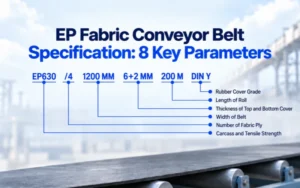
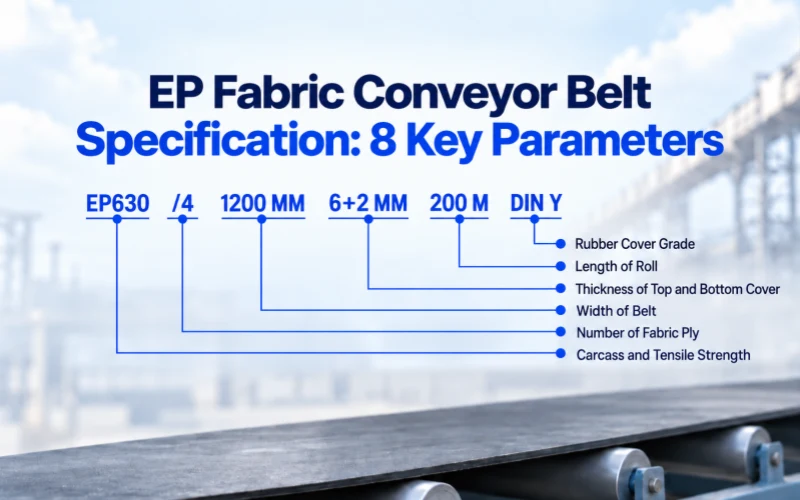
An EP fabric conveyor belt specification should define more than a strength code. The basic specification normally includes carcass type, finished belt tensile strength, number of fabric plies, belt width, top and bottom cover thickness, rubber cover strength, and belt length. These eight items establish the main product configuration.
For example, EP630/4 – 1200 mm – 6+2 mm – DIN Y – 200 m shows a complete basic specification. Here, 630 N/mm is the finished belt’s nominal longitudinal tensile strength, while 4 indicates four fabric layers. Some fabric suppliers also use EP ratings for individual fabric tensile strength, so you should confirm the marking basis before comparing EP belts.
2. Complete EP Fabric Conveyor Belt Specification
The eight key parameters in this article form the main purchasing description of an EP fabric conveyor belt. They are the first information you need when confirming a quotation or purchase order. A complete datasheet also contains additional technical values, such as elongation, adhesion, Shore hardness, and abrasion loss. These values provide a more detailed view of product quality and material performance.
2.1 The 8 Key Specification Parameters
For a standard EP fabric conveyor belt specification, I would first confirm these eight parameters:
- Carcass type— identifies the EP fabric construction.
- Finished belt tensile strength— states the nominal longitudinal tensile strength in N/mm.
- Number of fabric— identifies the number of fabric layers in the carcass.
- Belt width— defines the nominal belt width.
- Top cover thickness— specifies the rubber thickness on the carrying side.
- Bottom cover thickness— specifies the rubber thickness on the pulley side.
- Rubber cover strength— defines the required rubber cover performance or grade.
- Belt length— defines the required total or individual roll length.
These eight parameters establish the main product configuration and usually form the basis of a supplier quotation. They tell you exactly what belt is being ordered. However, they do not show every measurable property used to evaluate the quality of the carcass, bonding structure, or rubber compound.
2.2 Additional Technical Data in the Datasheet
A conveyor belt datasheet includes additional values such as elongation at reference force, elongation at break, interply adhesion, cover-to-carcass adhesion, Shore hardness, abrasion loss, etc.
These data provide a deeper technical description beyond the basic purchasing specification. They are especially useful when you compare products with similar main specifications because differences in elongation, adhesion, Shore hardness, or abrasion loss reflect differences in material properties and belt construction.
2.3 Purchase Order and Acceptance Information
A purchase order confirms the main belt specification, including tensile strength, number of fabric, width, cover thickness, rubber cover requirement, and length. It also records applicable supply details such as edge construction, open or endless delivery, roll quantity, applicable standard, and required inspection documentation.
Detailed performance values are controlled through the approved datasheet, technical specification, or referenced standard rather than repeated in every order line. This keeps the purchasing description concise while still providing a clear technical basis for product verification and acceptance.
EP Type | Rated Tensile Strength |
EP100 | 100 N/mm |
EP125 | 125 N/mm |
EP150 | 150 N/mm |
EP200 | 200 N/mm |
EP250 | 250 N/mm |
EP300 | 300 N/mm |
EP400 | 400 N/mm |
EP500 | 500 N/mm |
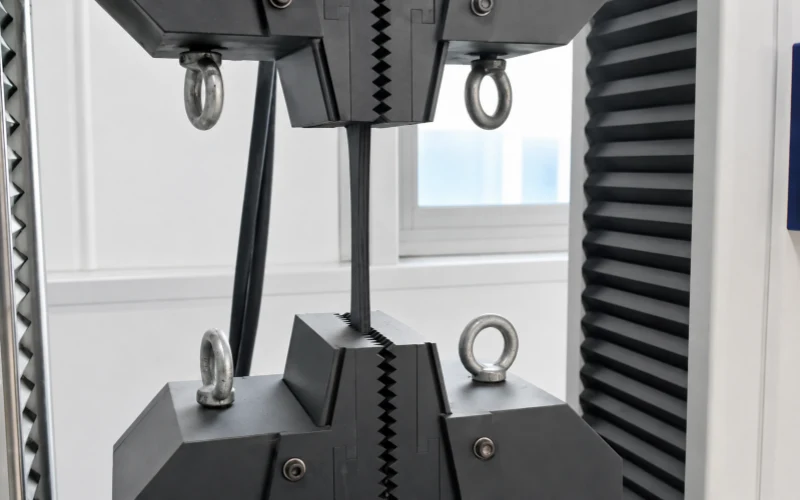
EP630 | 630 N/mm |
EP800 | 800 N/mm |
3. EP Carcass Material and Construction
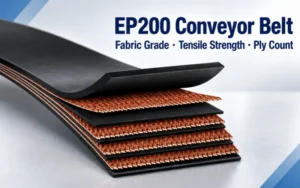
The carcass is the main reinforcement structure inside an EP fabric conveyor belt. Its specification depends on the fiber direction, number of fabric layers, and the bonding between those layers.
3.1 Polyester Warp and Polyamide Weft
E refers to the warp yarn of polyester fibers, and P refers to the weft yarn of polyamide fibers. Polyamide is also commonly known as nylon.
The warp yarns are arranged along the length of the conveyor belt and primarily bear the longitudinal tensile load. The weft yarns are arranged along the width of the belt and provide transverse strength, impact resistance, and flexibility. These two yarn directions together form the basic fabric structure of each layer of EP canvas.
3.2 Number of Fabric Layers
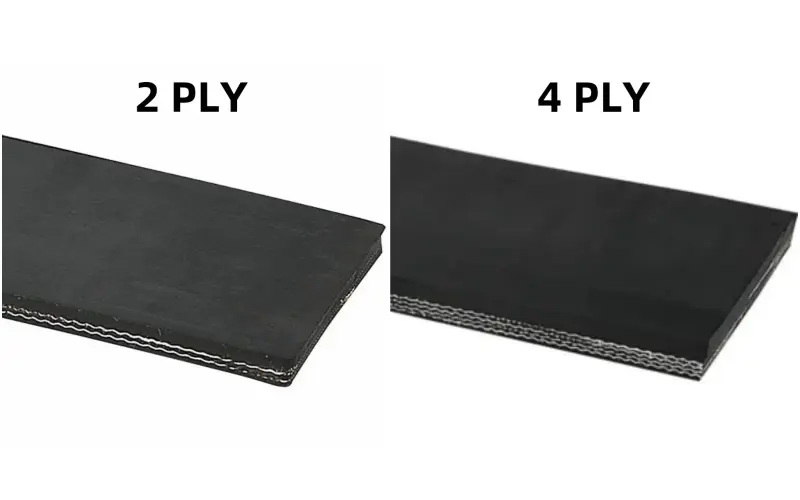
The number of fabric indicates how many EP fabric layers form the carcass. In a designation such as EP500/4, “4” means four fabric layers.
Increasing the number of fabric layers increases carcass thickness and generally increases bending stiffness. It also affects splice construction and the bending condition around pulleys.
More fabric layers do not automatically mean better performance. The required number should match the finished belt tensile strength and conveyor operating conditions.
3.3 Skim Rubber and Inter–ply Bonding
Skim rubber is applied between adjacent EP fabric layers before vulcanization. After curing, it bonds the fabric layers into one carcass and transfers load between them during operation.
Inter-ply bonding also limits relative movement between fabric layers during repeated pulley bending and loading impact. Poor adhesion can lead to interply separation or delamination.
Inter-ply adhesion should therefore be confirmed by a defined requirement or test result in the technical data-sheet.
4. Finished Belt Tensile Strength and Fabric Layer Configuration
In this article, EP together with the strength number forms the finished-belt strength rating. For example, EP500 represents a finished-belt strength class of 500 N/mm. The number after the slash identifies how many fabric layers are used in the carcass. This keeps the specification basis consistent.
4.1 Finished Belt Nominal Tensile Strength
In EP500/4, EP500 is the strength rating. The number 500 represents 500 N/mm, and 500 N/mm represents the nominal longitudinal tensile strength of the finished belt. The “4” indicates that the carcass contains four fabric layers.
For purchasing and product evaluation, you should first check the finished-belt tensile strength. Finished-belt tensile strength directly reflects the overall quality and performance formed by the fabric, skim rubber, and completed vulcanized structure.
4.2 Single-Layer Fabric Tensile Strength
Single-layer fabric tensile strength describes the longitudinal strength carried by one fabric layer in the carcass. For finished-belt comparison, an equivalent single-layer value can be calculated from the finished-belt tensile strength and the number of fabric layers.
For example:
- EP500/2: 500 ÷ 2 = 250 N/mm per layer
- EP500/3: 500 ÷ 3 ≈ 167 N/mm per layer
This calculation helps explain the carcass design. A two-layer belt must achieve the same finished strength with fewer reinforcement layers, so each layer requires a higher strength level. Higher-strength fabric normally increases material cost, which is why fewer-layer constructions at the same finished tensile strength are typically more expensive.
The single-layer value is therefore useful for understanding how the carcass reaches its finished strength, rather than replacing the finished-belt tensile strength used for product acceptance.
4.3 Full-Thickness Tensile Strength as the Main Reference
The finished conveyor belt works as a complete carcass, so full-thickness tensile strength provides the most direct strength reference. The test evaluates the combined structure after all fabric layers have been bonded and vulcanized together.
In practice, I would first compare the finished-belt tensile strength. The number of fabric layers and equivalent strength per layer are then used to understand how that strength is achieved. This avoids treating the strength of an individual reinforcement layer as if it represented the performance of the complete belt.
4.4 Same Finished Tensile Strength With Different Fabric Layers
EP500/3 and EP500/2 both specify a finished belt tensile strength of 500 N/mm, but their carcass constructions are different.
Construction Difference | EP500/2 | EP500/3 |
Finished tensile strength | 500 N/mm | 500 N/mm |
Number of fabric | 2 | 3 |
Equivalent strength per layer | 250 N/mm | About 167 N/mm |
Carcass thickness | Usually thinner | Usually thicker |
Belt weight | Lower | Higher |
Bending stiffness | Lower | Higher |
Small pulley adaptability | Generally better | Usually requires a larger pulley |
Transverse structural support | Relatively lower | Generally higher |
Splice construction | Simpler | More complex |
Typical cost | Higher-strength fabric usually raises cost | Lower-strength fabric can reduce fabric cost |
The two-layer construction is generally thinner, lighter, and easier to bend. This makes it more suitable when pulley diameter or repeated bending is important. The three-layer construction provides more fabric interfaces and generally stronger transverse structural support, which can be useful on wider or more heavily loaded belts.
However, three layers do not automatically mean better troughability or impact resistance. Troughability also depends on belt width, carcass thickness, fabric stiffness, and cover construction. Impact performance also depends on fabric properties, skim rubber, cover thickness, and the complete carcass design.
The key purchasing point is simple: more fabric layers do not automatically mean higher finished-belt tensile strength or better performance. Finished tensile strength defines the strength class; fabric layers define how the carcass achieves that class.
5. Belt Width Specification
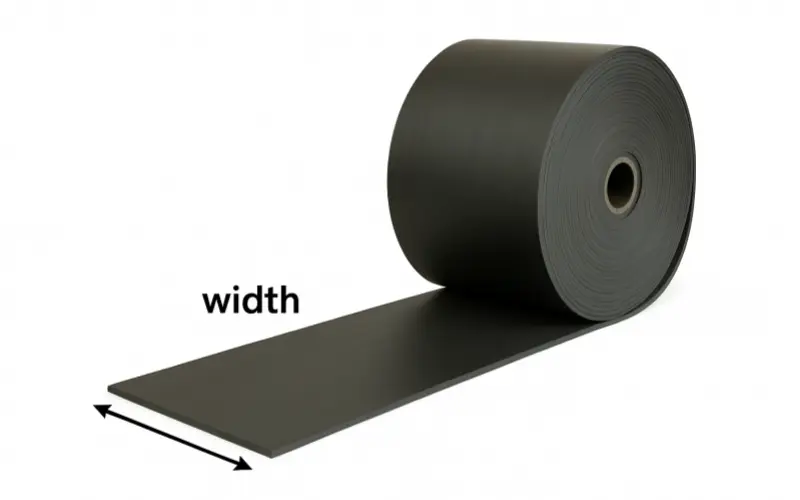
Belt width is the nominal transverse dimension of the finished conveyor belt, normally expressed in millimeters. For example, 1200 mm means the belt is manufactured to a nominal width of 1200 mm.
When confirming the width, you mainly need to check the original belt width for replacement or the specified belt width of the conveyor.
An undersized belt can reduce the available carrying surface, increase the risk of material spillage, and place more load near the belt edges. An oversized belt can create poor matching with idlers, pulleys, skirt systems, or surrounding structures, increasing the risk of edge contact and unstable tracking.
6. Top and Bottom Cover Thickness
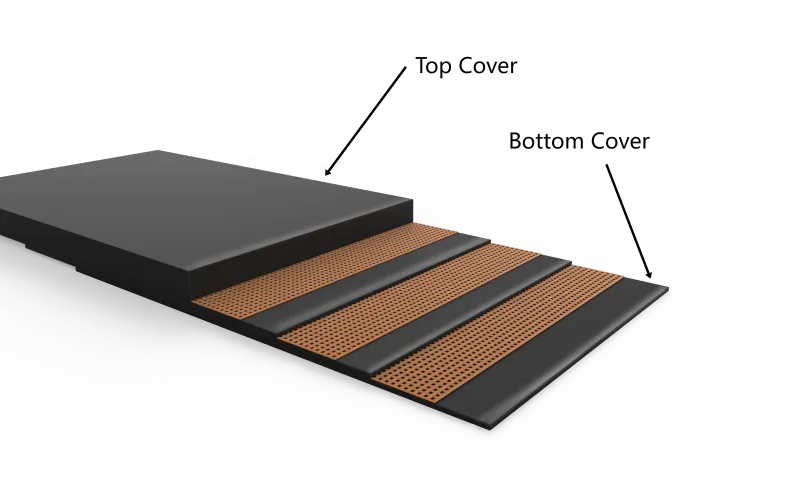
Top and bottom cover thickness describe the rubber thickness above and below the EP carcass. They are normally written together, such as 6+2 mm. The first value represents the top cover and the second represents the bottom cover.
6.1 Reading a 6+2 mm Cover Specification
A specification of 6+2 mm means:
- Top cover thickness:6 mm
- Bottom cover thickness:2 mm
These figures refer only to the rubber covers. They do not represent the complete thickness of the conveyor belt.
6.2 Top Cover Thickness
The top cover directly contacts the conveyed material. Its thickness provides the rubber reserve consumed by abrasion, impact, cutting, and other surface wear during operation.
Increasing top cover thickness gives more rubber available before wear reaches the carcass. It also increases rubber consumption, belt weight, cost, and bending resistance. For this reason, top cover thickness should be specified separately instead of being hidden inside a total belt thickness value.
6.3 Bottom Cover Thickness
The bottom cover protects the lower side of the carcass and contacts pulleys and supporting components during operation.
Because the wear conditions of the two working surfaces are different, the top and bottom covers can use different thicknesses. This is why specifications such as 5+2 mm or 6+2 mm are used to state the thickness distribution clearly.
The bottom cover should therefore be treated as an independent specification value rather than calculated automatically from the top cover thickness.
6.4 Carcass Thickness and Overall Belt Thickness
Cover thickness is different from overall belt thickness. A 6+2 mm specification does not mean the finished conveyor belt is 8 mm thick. The finished thickness also includes the EP carcass.
If an RFQ provides only the total cover thickness without specifying the top and bottom cover separately, we calculate the two covers at equal thickness for quotation. If a specific thickness distribution is required, the top and bottom values should be stated separately.
Our catalogue provides the following reference carcass thickness per ply for EP fabric constructions:
EP Fabric Type | Carcass Thickness (mm/ply) |
EP100 | 1.00 |
EP125 | 1.00 |
EP150 | 1.10 |
EP200 | 1.20 |
EP250 | 1.40 |
EP300 | 1.60 |
EP350 | 1.70 |
EP400 | 1.90 |
EP500 | 2.10 |
EP630 | 2.60 |
The table shows that carcass thickness changes with the EP fabric type. The number of fabric layers therefore also changes the finished carcass thickness. Overall belt thickness should be understood from top cover thickness + bottom cover thickness + carcass construction, rather than from the cover figures alone.
7. Rubber Cover Strength
Rubber cover strength describes the mechanical strength requirement of the cured cover compound and is expressed in MPa. One MPa equals one N/mm².
A cover grade normally combines rubber cover strength with elongation at break, abrasion loss, and Shore hardness. These values define different aspects of rubber performance and should be evaluated together when comparing cover compounds.
7.1 Main Physical Properties of Cover Rubber
Four values commonly appear in cover-rubber specifications:
- Rubber cover strength (MPa):defines the minimum mechanical strength of the cured rubber.
- Elongation at break (%):indicates how much the rubber can extend before rupture.
- Abrasion loss (mm³):measures rubber volume loss under a specified abrasion test. Lower values mean less material loss under the same test method.
- Shore hardness:defines the hardness range of the cured rubber.
Different cover grades use different combinations of these values. Higher rubber cover strength does not automatically correspond to lower abrasion loss or higher hardness.
7.2 Common Cover Rubber Grades
Different standard systems use different grade codes and performance limits. The following values show several commonly used cover-rubber grades recorded across the available specification systems.
Standard System | Grade | Rubber Cover Strength | Elongation at Break | Abrasion Loss | Shore Hardness |
DIN | W | ≥18 MPa | ≥400% | ≤90 mm³ | 60±5 |
DIN | X | ≥25 MPa | ≥450% | ≤120 mm³ | 60±5 |
DIN | Y | ≥20 MPa | ≥400% | ≤150 mm³ | 60±5 |
DIN | Z | ≥15 MPa | ≥350% | ≤250 mm³ | 60±5 |
ISO-type grading | H | ≥24 MPa | ≥450% | ≤120 mm³ | 60±5 |
ISO-type grading | D | ≥18 MPa | ≥400% | ≤100 mm³ | 60±5 |
ISO-type grading | L | ≥15 MPa | ≥350% | ≤200 mm³ | 65±5 |
Australian grading | A | ≥17 MPa | ≥400% | ≤70 mm³ | 60±5 |
Australian grading | M | ≥24 MPa | ≥450% | ≤125 mm³ | 60±5 |
Japanese grading | P | ≥8 MPa | ≥300% | ≤400 mm³ | — |
Japanese grading | S | ≥18 MPa | ≥450% | ≤200 mm³ | — |
British grading | M24 | ≥24 MPa | ≥450% | — | — |
British grading | B | ≥15 MPa | ≥350% | ≤150 mm³ | 60±5 |
U.S. grading | RMA1 | ≥17 MPa | ≥450% | ≤150 mm³ | 60±5 |
U.S. grading | RMA2 | ≥14 MPa | ≥400% | ≤175 mm³ | 65±5 |
The table shows that cover grades cannot be compared by the grade letter alone. For example, DIN W has a lower rubber cover strength than DIN X, while W has a lower abrasion-loss limit. Each grade represents a different balance of physical properties.
7.3 Matching Cover Grade to Surface Damage
Cover-rubber selection should follow the dominant damage mechanism on the belt surface.
Grades designed for severe abrasion normally place more emphasis on abrasion loss. Grades intended for cutting and tearing use a different combination of rubber cover strength and elongation. General-purpose grades provide another balance between mechanical strength, flexibility, and wear performance.
Some grading systems also include cover compounds for heat resistance, flame resistance, antistatic performance, food applications, and other special operating conditions.
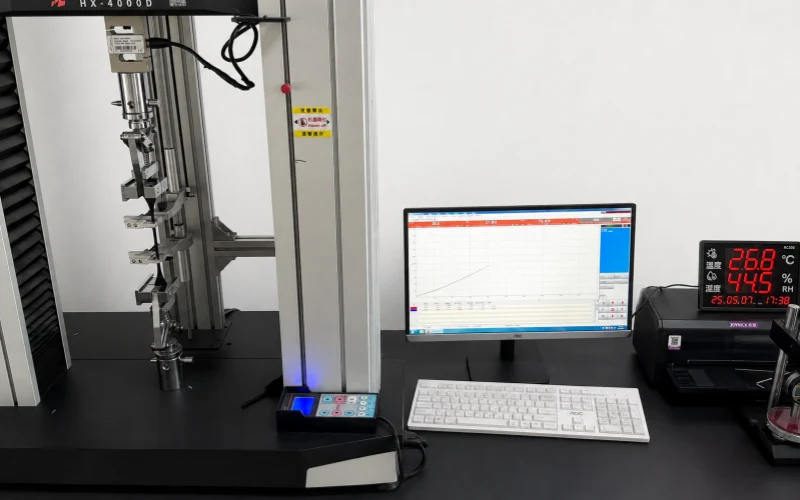
When preparing an RFQ, you can specify a recognized cover grade, or provide the required rubber cover strength, elongation at break, abrasion loss, and Shore hardness when those values are already defined.
8. Belt Length Specification
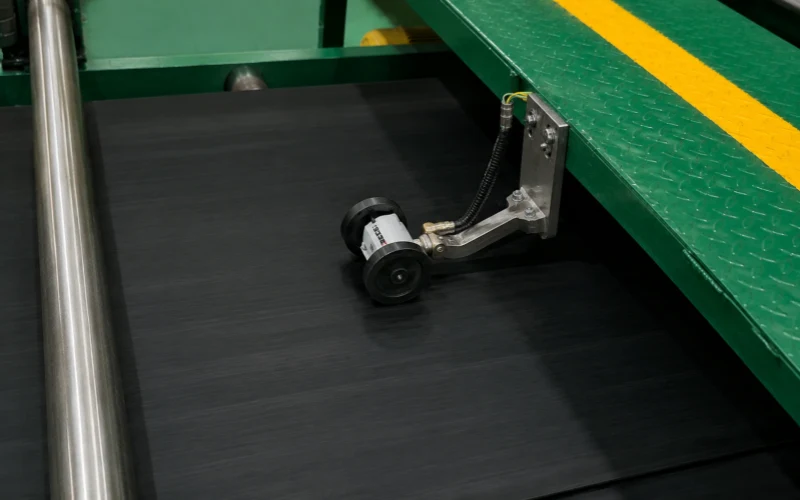
Belt length is the required finished length of the conveyor belt, normally expressed in meters. For purchasing, you mainly need to confirm the original belt length for replacement or the specified belt length of the conveyor.
The required length should also match the delivery form, such as an open belt or an endless belt.
Insufficient length can prevent installation or leave inadequate take-up adjustment. Excessive length increases unnecessary material cost and can require additional trimming or adjustment during installation. Therefore, the order should state the required belt length clearly.
9. Conclusion
A clear EP fabric conveyor belt specification should define the carcass type, finished belt strength, number of fabric layers, width, top and bottom cover thickness, rubber cover strength, and length. Confirming these eight parameters first makes quotations easier to compare and reduces specification errors before ordering.
10. FAQ
10.1 If Two Suppliers Quote the Same Basic Specification, What Should I Compare in Their Datasheets?
I recommend comparing the parameters that are not fully shown in the basic order description, including elongation at reference force, elongation at break, interply adhesion, cover-to-carcass adhesion, carcass thickness, Shore hardness, and abrasion loss. You should also confirm that both datasheets use the same test methods and acceptance criteria. This allows you to identify differences in carcass behavior, bonding quality, and rubber properties behind an apparently identical specification.
10.2 If My Existing Belt Uses a Different Ply Configuration, Can I Replace It With Another Construction at the Same Strength Rating?
I would first compare the carcass thickness, bending stiffness, pulley diameter, belt width, and actual operating tension. The same finished strength rating can be achieved with different numbers of fabric layers, but the resulting belt thickness, flexibility, weight, and pulley adaptability can differ. You should confirm that the new carcass construction remains suitable for the existing conveyor before changing the ply configuration.
10.3 If My Old Specification Uses a Cover Grade That Is No Longer Common, How Should I Find an Equivalent Grade?
I recommend starting from the original rubber-property requirements. You should extract the rubber cover strength in MPa, elongation at break, abrasion loss, Shore hardness, and any special performance requirement such as heat, oil, flame, antistatic, or chemical resistance. I would then compare those values with the current grade system and test basis. This gives you a measurable basis for approving an alternative cover compound.
10.4 If My Measured Belt Thickness Is Different From the Value I Calculated From the Covers and Carcass, Which Value Should I Use?
I would use the agreed finished-belt thickness in the datasheet or purchase specification when total thickness is an acceptance requirement. Your calculated value is useful for checking the construction, while the finished belt also includes the actual skim-rubber thickness and manufacturing variation created during calendering and vulcanization. You should therefore confirm the specified finished thickness and its measurement basis before deciding whether the difference is acceptable.
10.5 If I Only Know the Total Cover Thickness of My Existing Belt, How Should I Specify the Top and Bottom Covers for Replacement?
I recommend checking the original datasheet, purchase record, or a belt cross-section before placing the replacement order. The same total cover thickness can be distributed differently between the carrying side and pulley side. If you cannot confirm the original distribution, you should provide the total cover requirement and actual operating condition so the top and bottom cover arrangement can be confirmed before production.
10.6 If I Need to Change the Belt Width or Length During Replacement, What Should I Confirm Before Ordering?
I would treat any dimensional change as a conveyor compatibility check. For width, you should confirm the existing idler arrangement, pulley face width, loading area, and available structural clearance. For length, you should confirm the actual belt path, take-up position, splice allowance, and installation requirement. These checks are especially important when the replacement specification differs from the original belt instead of simply duplicating it.