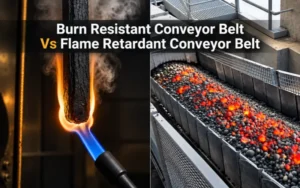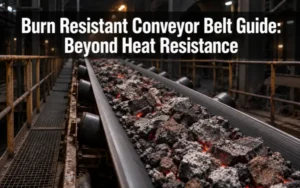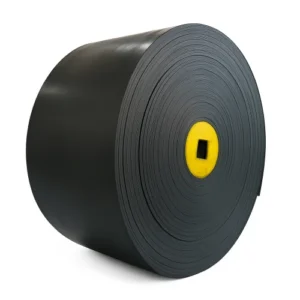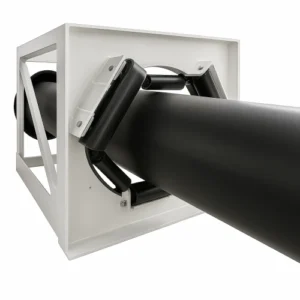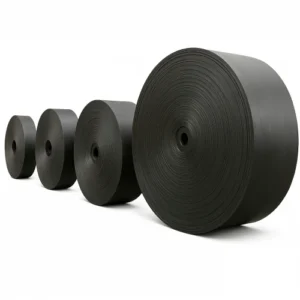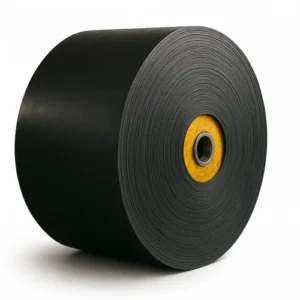
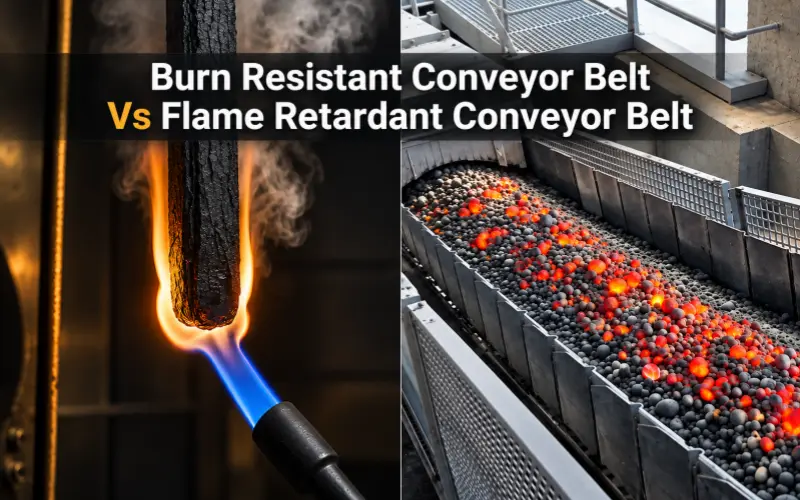
Burn resistance and flame resistance address different hazards. A burn resistant conveyor belt is designed for direct contact with incandescent or smoldering solid materials. Flame resistance controls how the belt burns after ignition. Confusing these properties can result in an unsuitable specification and unsupported performance claims.
The table below summarizes the main differences between burn resistant and flame resistant conveyor belts. Each comparison is explained in greater detail in the following sections.
Comparison Point | Burn Resistant Conveyor Belt | Flame Resistant Conveyor Belt |
Application | Transports incandescent or smoldering solid materials during normal production. | Used where open flames, electrical faults, frictional heat or other sources could ignite the belt. |
Source of exposure | Heat is stored inside the conveyed material and transferred to the belt through direct contact. | Heat comes from an ignition source acting on the belt. Where combustible dust is present, electrostatic discharge may also become an ignition source. |
Exposure process | Hot material remains on the belt from the loading point to the discharge point. The same belt section experiences repeated heating and cooling during operation. | The belt may be ignited accidentally. Its behaviour during exposure and after the ignition source is removed determines whether burning continues or spreads. |
Performance objective | Slows surface ablation and heat penetration so the cover can continue protecting the carcass. | Limits continued burning and flame spread. Antistatic performance reduces the risk of electrostatic discharge igniting combustible dust. |
Key selection data | Sustained and peak material temperatures, particle size and quantity, material bed thickness, loaded contact time, belt speed and return-run cooling time. | Required flame classification, applicable test method, belt construction and antistatic requirement. |
Performance verification | Datasheet values support preliminary selection. Actual service records from comparable materials and operating cycles provide the main evidence of burn-resistant performance. | Flame and antistatic Test Reports should correspond to the specified test methods, supplied belt construction and production batch. |
1. Burn Resistance and Flame Resistance Address Different Hazards
1.1 Burn Resistance Protects Against Incandescent or Smoldering Materials
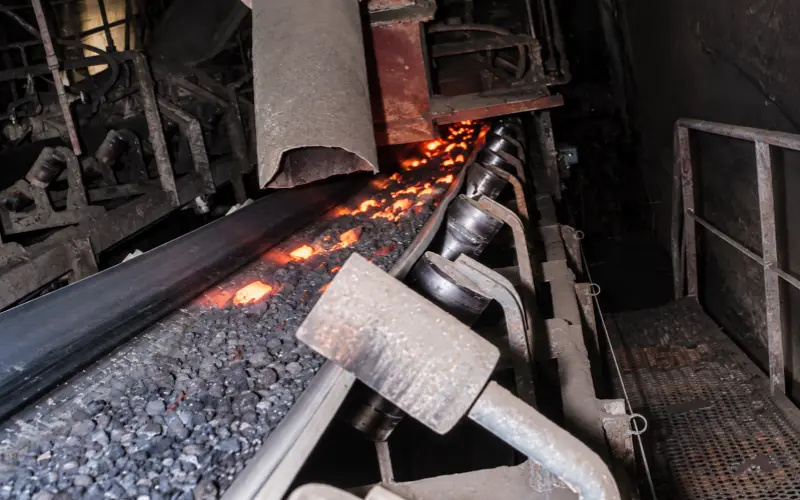
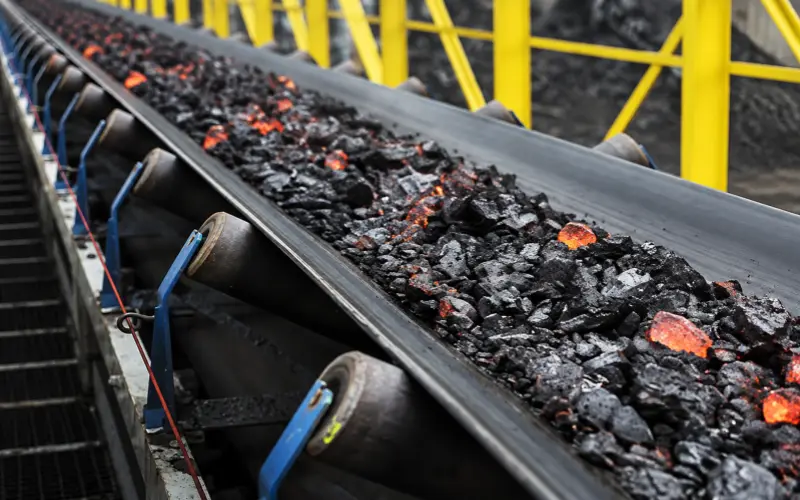
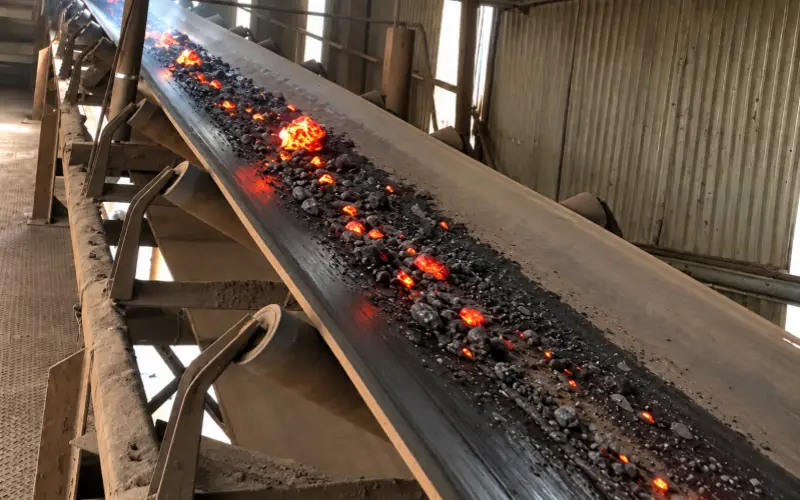
Burn resistance is required when solid materials reach the belt in an incandescent, glowing, or smoldering state. Typical examples include glowing sinter, hot coke containing smoldering particles, recently solidified slag, and steelmaking residues that retain intense heat. Some materials are undergoing flameless combustion. Others glow because of retained thermal energy. Both conditions can burn the belt surface without producing a visible flame.
These materials transfer concentrated heat through relatively small contact areas. Larger pieces may also strike the belt, press into the top cover, or remain temporarily at one location. The combined effects of heat, impact, and contact pressure can cause:
- Surface charring and localized ablation
- Deep pits and thermal cracks
- Localized blistering
- Delamination between the cover rubber and carcass or between fabric plies
- Progressive loss of top cover thickness
The defining hazard is direct contact with incandescent or smoldering solids. A burn resistant conveyor belt must control the development of charring, pitting, cracking, and cover loss under this concentrated thermal load. This requirement goes beyond conventional heat-resistant applications in the 100-250°C range currently common in the market.
1.2 Flame Resistance Controls Burning After Ignition
Flame resistance evaluates how a conveyor belt behaves during and after exposure to a specified ignition source. In a laboratory Flame Test, a sample is exposed to a controlled flame for a defined period. After the burner is removed, the flame that remains on the sample is the afterflame. The time required for this flame to go out is recorded as the afterflame time.
Afterflame time is the most important and direct indicator because it shows how quickly the belt stops supporting visible flaming once the external ignition source has been removed. A shorter result does not independently establish compliance, however. The measured time must be compared with the limits specified by the applicable standard and flame-resistance grade.
A laboratory Flame Test evaluates more than one extinguishing time. Depending on the standard, the Test Report may include:
- The flame duration of each sample
- The total flame duration for a group of samples
- The maximum recorded value
- Whether a flame reappears after an airflow is applied
- The duration of any reappearing flame
- Results for the required sample preparation and test conditions
Passing the Flame Test means that all applicable results satisfy the limits of the specified standard. It does not mean the belt cannot be ignited. It also does not mean the belt will extinguish smoldering conveyed material.
A flame resistant conveyor belt controls its own burning behavior after ignition. This performance does not prove that its top cover can withstand direct contact with incandescent solids. A burn-resistant construction must therefore undergo the corresponding Flame Test before any flame-resistance claim can be confirmed.
1.3 Why Burn Resistance and Flame Resistance Are Frequently Confused
The word “burn” can describe physical damage to the cover rubber or the combustion of the conveyor belt itself. Commercial terminology is also inconsistent. One supplier may use scorch resistant conveyor belt for direct contact with glowing material, while another may use “burn resistant” for a heat-resistant or flame-retardant grade.
The following terms have distinct meanings in this article:
- Burn resistance:Protection against charring, ablation, pitting, cracking, blistering, and cover loss caused by direct contact with incandescent or smoldering solids.
- Flame resistance:Control of the belt’s combustion behavior after ignition. Afterflame time is the principal indicator, while the applicable standard may include additional test results and acceptance limits.
Heat resistance must also remain separate. A high temperature rubber conveyor belt designed for conventional hot-material applications does not automatically provide protection against glowing or smoldering pieces. Likewise, a fire resistant conveyor belt or flame retardant conveyor belt controls combustion after ignition but does not prove resistance to direct scorching by the conveyed material.
If an RFQ specifies only an “anti-burning conveyor belt,” one supplier may quote a heat-resistant grade, another may offer a flame-resistant grade, and a third may interpret it as a burn-resistant construction. Their prices, Test Reports, and temperature claims will not be directly comparable.
The RFQ should therefore describe the actual state of the conveyed material. It should also state whether the required protection concerns direct scorching of the top cover, combustion of the belt after ignition, or two requirements that must be specified and verified separately.
2. Why Flame Resistance Does Not Establish Burn Resistance
2.1 Application Determines the Rubber Formulation
The required conveyor belt should first be selected according to the main hazard in the application.
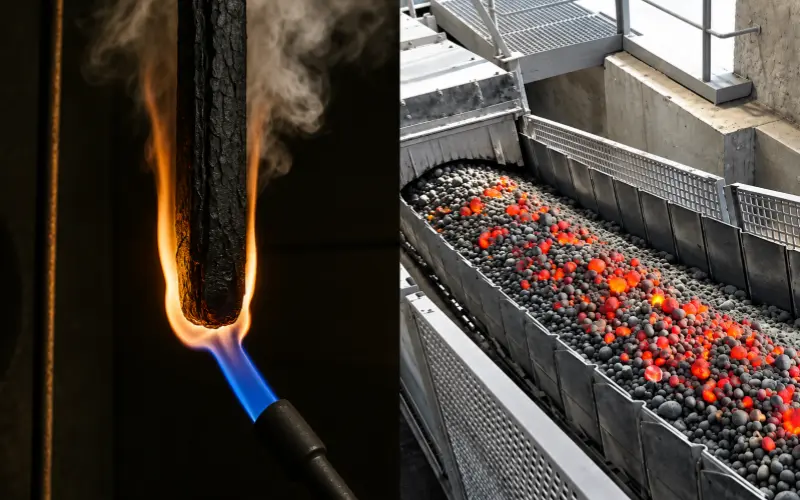
A flame resistant conveyor belt is developed for conditions involving open flames, electrical faults, frictional heating, or electrostatic discharge that ignites combustible dust and triggers a dust explosion. Its rubber formulation focuses on achieving the required burning behaviour under the specified flame standard.
A burn resistant conveyor belt is developed for direct contact with incandescent or smoldering solids. Its Cover Rubber must withstand concentrated thermal attack from materials such as glowing sinter, smoldering coke and recently solidified slag.
These products have different application objectives and use different formulation directions.
For current procurement and belt selection, the two properties should be treated separately. Any claim covering both properties would require finished-belt evidence for each performance and cannot be established from a formulation description or a single Test Report.
2.2 Direct Contact Creates a Different Thermal Exposure
An ignition source and an incandescent solid transfer heat to the belt in different ways. Therefore, flame-test results cannot be used directly to assess burn resistance.
An incandescent material stores heat within its mass. After it lands on the belt, direct contact continues to transfer heat into the Top Cover.
A large or dense piece can contain more thermal energy than a smaller particle at the same temperature. Impact may also press an irregular piece into the Cover Rubber, increasing the contact area.
The surrounding material bed can slow cooling and extend the heating period. If the belt does not release enough heat during the return run, residual heat may remain when the same section returns to the loading point.
The actual thermal exposure depends on several connected conditions:
- Material temperature, mass and heat capacity;
- Particle size and contact area;
- Material bed thickness;
- The time the conveyed material remains in contact with the belt surface and the belt speed;
- Return-run length and cooling conditions.
These operating factors fall outside the evidence provided by a conventional flame test. Passing that test cannot be used to classify the belt as suitable for direct contact with incandescent materials.
2.3 If an Existing Belt Has Been Damaged
This check is only necessary when an existing belt has already developed thermal damage:
- Specification:Was burn resistance clearly included in the order?
- Operating conditions:Did temperature, loading, belt speed or cooling conditions change?
- Delivered product:Does the belt and its Test Report match the contracted construction and production batch?
These checks help separate specification mismatch, operating changes and product quality without deciding the cause in advance.
3. How Burn-Resistant Conveyor Belts Protect the Carcass
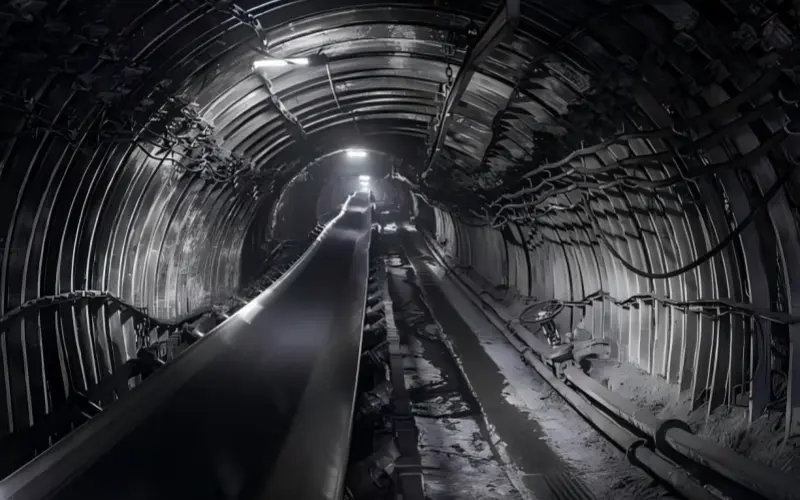
3.1 A Stable Char Layer Forms a Sacrificial Barrier
For a burn-resistant cover compound designed to carbonize under severe thermal exposure, surface charring is part of its protective mechanism. As long as the char layer remains continuous and firmly attached, it separates the unaffected cover rubber from direct contact with incandescent or smoldering material and slows the downward progression of ablation.
The effectiveness of this layer cannot be judged solely by its darkened appearance. Inspection should focus on its continuity, attachment to the remaining cover and the depth of material loss. Cracking, loosening or removal of the char layer allows the underlying cover to be attacked directly.
3.2 Cover Thickness and Adhesion Protect the Carcass Differently
Top cover thickness provides a consumable rubber section between the conveyed material and the carcass. It increases the distance heat must travel and delays the temperature rise at the skim rubber and carcass during each conveying cycle. As the surface is gradually consumed, the remaining cover thickness represents the physical protection still available.
Adhesion does not provide thermal insulation. Its function is to keep the top cover securely attached to the carcass during impact, thermal cycling and repeated flexing around pulleys. If this bond fails, the cover can lift, crack or peel locally, and its full protective thickness is no longer maintained at that point.
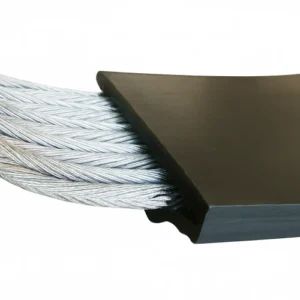
For a fabric carcass, interply adhesion keeps the plies consolidated and limits the spread of separation. For a steel cord carcass, cord-to-rubber adhesion keeps the cords securely embedded within the belt structure. Cover thickness determines the available thermal barrier, while adhesion preserves its structural continuity.
3.3 Operating Conditions Define the Temperature Rating
Under confirmed operating conditions, our burn resistant conveyor belt can continuously convey solid materials at material temperatures up to 500°C. It can also handle a short-duration peak material temperature up to 800°C during intermittent or localized temperature peaks. Both figures refer to the conveyed material temperature at the agreed measurement point.
The temperature rating is connected to the thermal cycle experienced by each section of the belt. Loaded-run residence time begins when the material is placed on the belt and ends at the discharge point. Return-run cooling time begins after discharge and continues until the same belt section reaches the loading point again.
For an 800°C peak, the applicable exposure duration is established according to the quantity and distribution of peak-temperature material, the belt area affected and the available cooling interval. It is therefore evaluated against the actual operating cycle rather than expressed as a universal number of seconds.
4. Match the Conveyor Belt to the Actual Hazard
4.1 Applications Where Burn Resistance Is the Primary Requirement
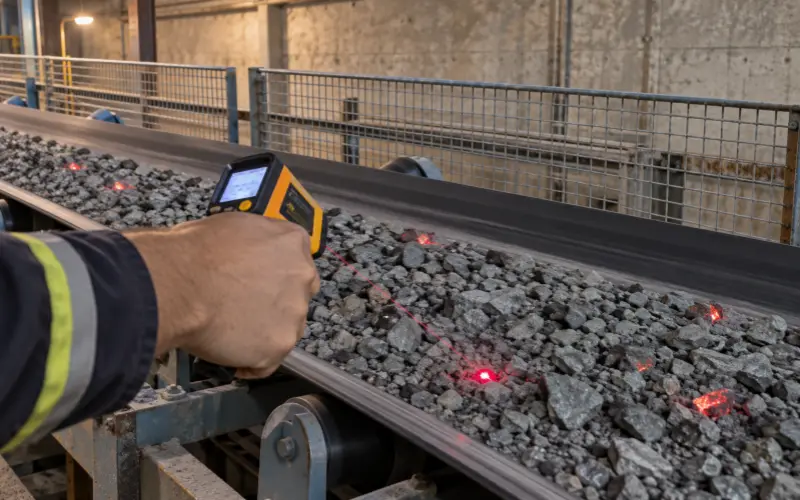
At each loading point, extract normal material temperatures, recurring peaks and their duration from the plant’s operating records. Keep separate feed streams identifiable so a blended average does not conceal hotter incoming material. For crushed material, use measurements after crushing. Record the instrument and measurement location alongside each reading so the supplier can distinguish surface temperatures from measurements within the material.
To qualify a proposed burn resistant conveyor belt, agree a hot-contact test using representative material or a defined substitute. Document contact temperature, exposure time, contact load and cooling between cycles. Keep unexposed specimens from the same belt as a baseline for comparing adhesion before and after thermal exposure. Examine cooled test sections for damage depth and carcass exposure, then compare post-test adhesion with the agreed minimum. Set these acceptance limits before testing. A test performed under different contact conditions needs a technical explanation before its results support your application.
4.2 Applications Where Flame Resistance Is the Primary Requirement
For flame-resistant belts, build an acceptance sheet from the specified fire category. Put each required test, specimen condition and acceptance limit on a separate line. Enter the corresponding measured result from the laboratory report beside it. If the category requires tests with covers removed, a report covering only intact specimens leaves that requirement unverified. Apply individual and group limits separately wherever both are specified.
For delivery acceptance, match the belt’s marking and batch records to the ordered construction and relevant reports. Check conductivity in its own results section. ISO 284 specifies electrical-resistance requirements and the corresponding test method. Compare the reported resistance with the limit in the specified edition, including any stricter contractual requirement. Keep the resistance units beside each value to avoid confusing ohms with megaohms. Missing results remain open acceptance items; a flame-test pass does not close an outstanding conductivity requirement.
4.3 Applications Requiring Both Properties
Use one requirement sheet for each conveyor, identified by equipment number. For separate hot-material and fuel-handling conveyors, keep the selected grades and acceptance records separate. For one belt facing both hazards, link both sets of evidence to the same proposed construction. A burn-test report for one compound and a flame-test report for another do not establish suitability for the ordered belt.
If no candidate is supported for both duties, assess upstream cooling or removal of hot pieces. Repeat the loading-point measurements after the change, including recurring peaks. Use those recorded conditions to reassess the downstream belt, while retaining the applicable fire requirements. This provides a measurable basis for changing the belt specification.
5. Common Mistakes When Selecting Burn or Flame Resistance
5.1 Treating Burn Resistance and Flame Resistance as Interchangeable
Identify the actual hazard before selecting the belt. A burn resistant conveyor belt is required when incandescent or smoldering solids directly contact the belt. Flame resistance applies when the risk involves ignition, continued burning or flame propagation.
Record these as separate requirements. Burn resistance does not establish flame resistance, and flame resistance does not establish protection against incandescent material. If both hazards occur on the same conveyor, each property requires separate finished-belt verification.
5.2 Confusing Instantaneous Readings With Short-Duration Peaks
Every reading from a handheld infrared thermometer represents the instantaneous surface temperature of material passing the measurement point. Whether the reading represents sustained exposure or an isolated peak depends on the pattern formed by repeated measurements.
Choose a fixed measurement point at the outlet of the transfer chute, immediately before the material contacts the receiving belt. Keep the distance, angle and target area consistent. This position captures the incoming material before water spraying or other cooling along the conveyor reduces its temperature.
Measure throughout a representative high-load operating period. Observe whether readings near the upper temperature range remain present throughout the normal material flow or appear only when isolated incandescent pieces pass.
The upper range that persists during normal conveying should be compared with the belt’s continuous material-temperature capability. Isolated higher readings should be compared with its peak material-temperature capability. Peak selection should also consider how frequently these pieces occur and how long the material remains on the belt between loading and discharge.
The minimum reading only describes temperature variation within the material flow. It does not reduce the local thermal exposure created by the hottest pieces.
5.3 Leaving No Measurable Safety Margin
The temperature margin should be based on measurable uncertainty and operating variation.
For continuous exposure:
Required continuous capability = upper sustained temperature + positive thermometer tolerance + measured process allowance
The thermometer tolerance comes from the instrument specification. The process allowance can be obtained by comparing the upper sustained temperature during normal high-load operation with the result recorded under the most severe permitted combination of feed rate and cooling performance.
For peak exposure:
Required peak capability = highest measured peak + positive thermometer tolerance
The peak temperature must also remain within the verified limits for exposure duration, material quantity and occurrence frequency.
If the most severe permitted operating condition cannot be measured, select a construction with a higher verified temperature capability and confirm the remaining margin through an on-site trial.
5.4 Treating a Data–sheet as Final Performance Proof
A Data-sheet records the performance declared for a product and should only be used as a technical reference. It does not reproduce the material impact, contact time, water cooling, temperature distribution or repeated thermal cycles of the actual conveyor.
A standardized laboratory report can verify one specific property under defined test conditions. For flame resistance, it provides evidence of the tested specimen’s burning behaviour. Laboratory burn-resistance results can also support initial product screening when the test conditions are clearly stated.
Only an on-site trial can confirm whether the proposed burn-resistant construction performs under the actual application. The trial should use the proposed belt construction and the conveyed material under normal production conditions. After an agreed number of complete belt cycles, inspect the remaining cover thickness, damage depth, cracking, adhesion and carcass condition. These findings provide the final basis for acceptance or further adjustment.
6. Burn Resistance Supports Hot-Material Conveying; Flame Resistance Controls Fire Risk
A burn resistant conveyor belt is made for transporting incandescent or smoldering solids. These materials are already hot when they reach the loading point. The belt must withstand repeated direct contact and protect the carcass so that conveying can continue reliably.
A flame resistant conveyor belt is used where a fire could occur. An open flame, an electrical fault or frictional heating may ignite the belt. If this happens, the belt should stop burning after the ignition source is removed and limit flame spread. Where combustible dust is present, antistatic performance is also needed to reduce the chance of a static spark igniting the dust.
Select burn resistance according to the material being conveyed. Select flame resistance and antistatic performance according to the site’s fire and explosion safety requirements. If the same conveyor requires both, specify the two properties separately because one cannot establish the other.
7. FAQs
7.1 How Should Cleaner Pressure Be Adjusted on a Burn-Resistant Belt?
Set the cleaner at the lowest pressure that removes carryback across the belt width. After several complete cycles, increase pressure only where residue remains. Reduce or realign it if rubber dust, polished grooves, blade chatter or a hot contact line appears.
7.2 How Should Skirt Rubber Be Set in a Hot-Material Loading Zone?
Set skirt rubber to light, even contact across the loading zone; it should seal fines without bending deeply or carrying material load. After the first loaded run, inspect for heat, polishing or rubber dust. Raise or realign it at hot or heavily polished spots and eliminate lump trapping.
7.3 What Should Be Changed When Damage Follows One Narrow Strip?
Trace the strip back to the material stream at the chute. Reposition the deflector or adjust the chute so large hot pieces spread across the intended loading width. Confirm that the change does not create side loading, skirt trapping or belt mistracking.
7.4 How Should Service Life Be Compared Between Two Burn-Resistant Belts?
Compare cover loss at the same marked locations per operating hour or per conveyed ton. Record material temperature, throughput, belt speed and loading pattern for each period. Calendar months alone are misleading when the two belts complete different numbers of loaded cycles.
7.5 Can Standard Repair Rubber Be Used on a Burn-Resistant Belt?
Use repair rubber only when its thermal behavior, adhesion system and curing method are compatible with the original cover. A standard patch may soften, crack or detach earlier than the surrounding belt. Record the repaired area so its condition can be checked separately.