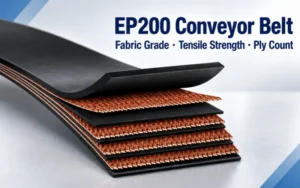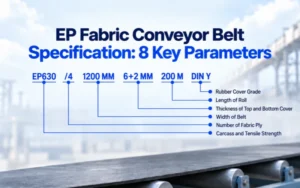
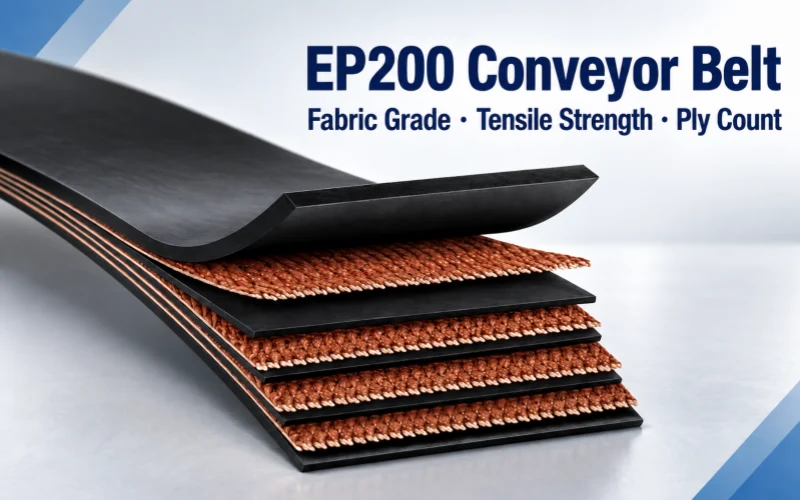
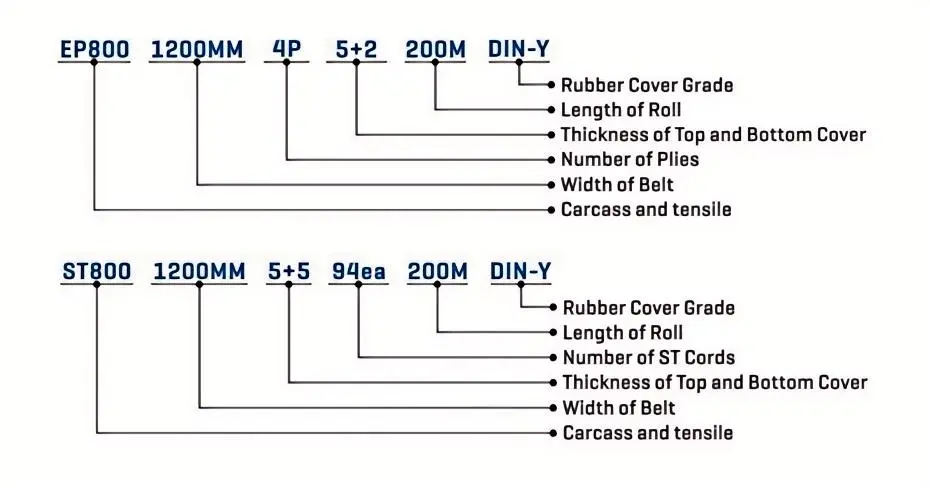
EP200 conveyor belt specifications use 200 in two ways. In EP200/2, it is the 200 N/mm Finished Belt Tensile Strength across two fabric plies. In EP200 × 2, it is the grade of each ply, producing a nominal Finished Belt Tensile Strength of 400 N/mm.
1. Where EP200 Sits in the Belt Specification
A complete specification separates the carcass material, the strength of each fabric ply, and the strength of the finished belt. EP identifies the material system. The fabric grade belongs to each ply, while the finished belt value belongs to the complete carcass. Calling all three simply “EP200 strength” is where quotation errors start.
1.1 What EP200 Means at the Fabric Level
EP fabric has polyester yarns in the warp direction and polyamide, commonly called nylon, in the weft direction. Warp yarns run lengthwise and carry longitudinal tension. Weft yarns run across the belt and help the carcass form a trough over the idlers.
When EP200 is used as a Fabric Grade, 200 refers to the nominal longitudinal tensile strength of one fabric ply, expressed in N/mm. It does not state the Number of Fabric Plies, Finished Belt Tensile Strength, or cover construction. Those values must be specified separately.
1.2 How Fabric Grade and Ply Count Determine Belt Strength
The Number of Fabric Plies connects the Fabric Grade to the Finished Belt Tensile Strength. This is why EP200/2 and EP200 × 2 should not be treated as equivalent specifications.
Notation | Fabric Grade | Number of Fabric Plies | Finished Belt Tensile Strength |
EP200/2 | Not shown in this notation | 2 | 200 N/mm |
EP200 × 2 | EP200 | 2 | 400 N/mm |
The second row can also be written as EP400/2. These are different ways of presenting the same two-ply construction. Neither style is limited to a particular document. Buyers may encounter either form in inquiries, quotations, orders, or belt markings.
Finished Belt Tensile Strength applies to the complete belt and is expressed as force per unit belt width. It is measured using a full-thickness specimen. Fabric Grade, by comparison, describes the reinforcement selected for each individual ply.
1.3 What Must Be Compared in a Quotation
After confirming the strength notation, compare the remaining fields separately. Belt Width and Belt Length define the ordered dimensions. Top Cover Thickness, Bottom Cover Thickness, and Cover Rubber Grade define the cover construction. Two quotations that both mention EP200 may still differ in finished strength, ply count, or the amount and grade of cover rubber supplied.
The same Finished Belt Tensile Strength can also be achieved with different fabric grades and ply counts. Those differences may change the belt thickness, flexibility, splice construction, and pulley requirements. The strength figure alone therefore does not show whether two belts have the same construction.
2. How We Read EP200/2, EP200/3, and EP200/4 in Quotations
In routine sales work, we read EP200/2 as a Finished Belt Tensile Strength of 200 N/mm with two fabric plies. We prepare the quotation on this basis without asking you to restate the specification. A second confirmation is needed only when this interpretation would require a Fabric Grade below EP100.
2.1 EP200/2 Is Quoted as 200 N/mm Total Strength
With EP200/2, the nominal total strength is divided across two fabric plies. This corresponds to 100 N/mm per ply, which matches the regular EP100 Fabric Grade. We therefore treat EP200/2 as a normal two-ply belt with a Finished Belt Tensile Strength of 200 N/mm and proceed with the quotation.
Only a small share of the inquiries we receive each year use EP200/2 to mean two EP200 fabric plies and a nominal total strength of 400 N/mm. Some of those entries are simply typing errors. These exceptions do not change our default interpretation or justify asking you to reconfirm every standard EP200/2 inquiry.
2.2 We Confirm Only When the Result Falls Below EP100
EP100 is the lowest regular single-ply Fabric Grade we normally use. Even if your required Finished Belt Tensile Strength is below 100 N/mm, production usually still starts with EP100 fabric.
Your Entry | Calculation Under the Total-Strength Interpretation | Comparison With EP100 | Our Handling |
EP200/2 | 200 ÷ 2 = 100 N/mm per ply | Matches EP100 | Prepare the quotation directly |
EP200/3 | 200 ÷ 3 ≈ 66.7 N/mm per ply | Below EP100 | Ask you to confirm once |
EP200/4 | 200 ÷ 4 = 50 N/mm per ply | Below EP100 | Ask you to confirm once |
EP200/3 and EP200/4 cannot be treated as routine 200 N/mm finished-belt constructions because the calculated strength of each ply falls below the regular EP100 minimum. This is the point at which we contact you for confirmation.

3. Selecting the Number of Fabric Plies
Replacement belts and belts for new conveyor systems follow different selection methods. A replacement belt uses the previous belt as its reference. A new conveyor requires the fabric grade and ply count to be selected from its operating conditions and design requirements. EP200 is used here as a comparison example.
3.1 Selecting a Replacement Belt
When replacing an existing belt, you decide whether to retain its original carcass type, Finished Belt Tensile Strength, and Number of Fabric Plies. We prepare the quotation according to the specification you confirm.
The previous purchase order, belt marking, technical data sheet, or a sample taken from the old belt can be used to identify its original construction. If the old belt operated normally, the confirmed specification provides the most direct reference for the replacement.
Abnormal damage caused by insufficient total strength includes tensile rupture of the carcass across part or all of the belt width, permanent elongation beyond the available take-up travel, and repeated tensile failure of a correctly made splice.
If the old belt experienced these problems, you can consider selecting a higher Fabric Grade, increasing the Number of Fabric Plies, or combining both adjustments.
3.2 Selecting a Belt for a New Conveyor
For a new conveyor, selection starts with the actual application and conveyor design. Besides basic information such as Belt Width, conveying capacity, and conveyor length, the design must also consider operating tension, starting and braking loads, lift, drive and take-up arrangement, pulley diameters, troughing requirements, and splice method.
These conditions establish the required Finished Belt Tensile Strength and the structural limits of the carcass. Different fabric grades and ply counts can then be compared. EP200 is one available Fabric Grade within this comparison.
3.3 EP200 Conveyor Belt Comparison: Two to Five Plies
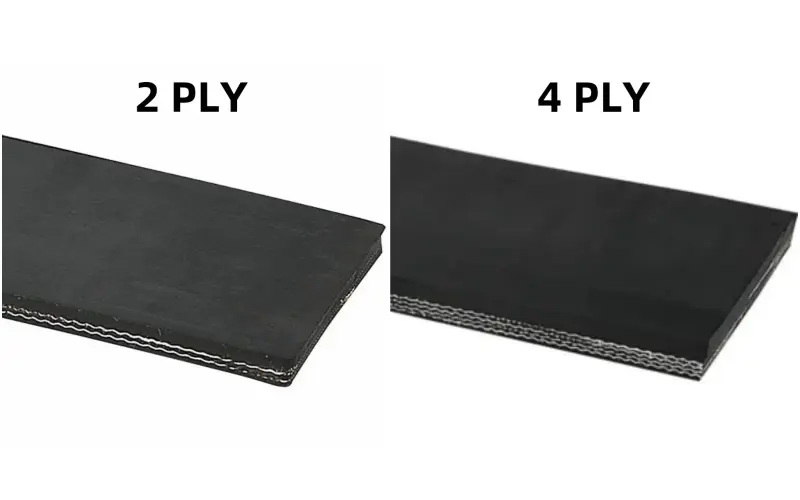
Based on Tiantie Industrial’s quotation experience, two-, three-, four-, and five-ply constructions are the most commonly requested options when EP200 fabric is used.
The following comparison uses the same EP200 fabric specification, interply rubber, Belt Width, Top Cover Thickness, and Bottom Cover Thickness. Only the Number of Fabric Plies changes.
Number of Fabric Plies | EP200 Construction | Finished-Belt Designation | Nominal Finished Belt Tensile Strength | Main Advantages | Main Limitations |
2 | EP200 × 2 | EP400/2 | 400 N/mm | Lowest carcass thickness, weight, and bending stiffness; least splice preparation | Lowest total strength and transverse support in this comparison |
3 | EP200 × 3 | EP600/3 | 600 N/mm | Higher total strength and transverse support while retaining a lighter carcass than four- or five-ply options | Greater thickness, stiffness, and splice workload than the two-ply construction |
4 | EP200 × 4 | EP800/4 | 800 N/mm | Double the nominal total strength of the two-ply construction and greater transverse reinforcement | Heavier and stiffer carcass with more splice preparation |
5 | EP200 × 5 | EP1000/5 | 1,000 N/mm | Highest total strength and transverse support among these commonly quoted constructions | Greatest carcass thickness, weight, bending stiffness, and splice workload |
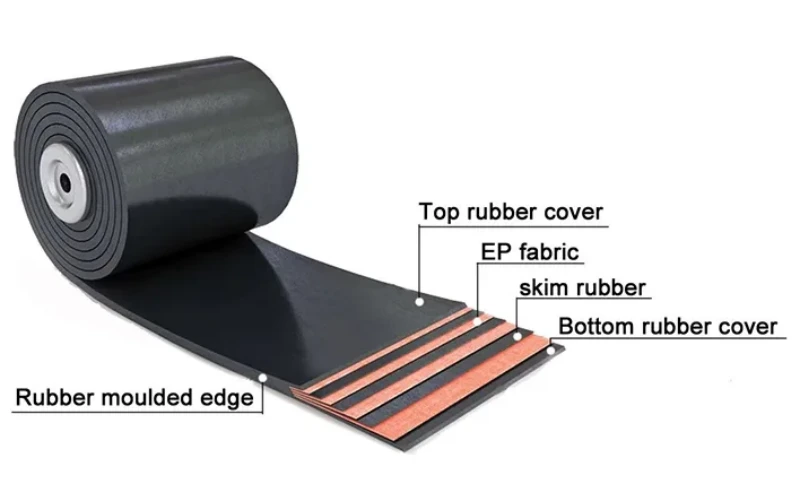
Each additional EP200 ply contributes a nominal 200 N/mm and adds one fabric layer with its corresponding interply rubber. The increase in finished-belt thickness therefore comes from the additional fabric and interply rubber. Top and bottom cover thicknesses remain separate specification items.
The preferred construction uses the fewest plies that satisfy the required total strength and transverse support while remaining compatible with the conveyor and splice requirements. When additional EP200 plies would make the carcass unnecessarily thick or stiff, a higher Fabric Grade should also be evaluated.
4. How the Required Finished-Belt Strength Is Determined
The conveyed material and Belt Speed affect the material load carried per metre, but they do not determine the maximum belt tension independently. Conveyor length, vertical lift, belt weight, running resistance, drive and take-up arrangement, and starting and braking loads must also be included.
The calculation produces the maximum tensile force at the most heavily loaded point of the belt. This force is normally expressed in newtons and is converted to tension per unit width before belt selection:
Maximum Tension per Unit Width = Maximum Belt Tension ÷ Belt Width
The minimum Finished Belt Tensile Strength is then determined by the required Safety Factor:
Minimum Finished Belt Tensile Strength = Maximum Tension per Unit Width × Required Safety Factor
The required Safety Factor follows the applicable design standard or project specification. It is necessary because Finished Belt Tensile Strength is the nominal breaking strength of a full-thickness belt specimen, rather than its allowable continuous operating tension. The selected calculation method must also account for the strength retained by the splice.
5. A Clear Strength Basis Makes an EP200 Conveyor Belt Quotation Reliable
Defining what the 200 in EP200 represents ensures that your inquiry, our quotation, production instructions, and final inspection use the same carcass specification. It prevents Finished Belt Tensile Strength from being confused with the Fabric Grade of each ply and avoids differences between the quoted and manufactured carcass.
Our quotation process keeps routine inquiries simple. We follow the usual total-strength interpretation and contact you only when the implied strength per ply falls below EP100 or conflicts with another confirmed requirement. This prevents an unclear notation from entering production without asking you to resubmit information that is already clear.
The final order should record the Finished Belt Tensile Strength and fabric construction together. Sales, engineering, production, and inspection can then work from one confirmed specification, reducing repeated communication and preventing the wrong carcass from being manufactured.

6. FAQs
6.1 Does Belt Width Change EP200 Conveyor Belt Tensile Strength?
The rated strength in N/mm remains unchanged when the Belt Width changes. A wider belt has a greater nominal tensile force across its full width, but belt selection still compares the maximum tension per unit width with the Finished Belt Tensile Strength.
6.2 Does a Thicker Rubber Cover Increase Finished Belt Tensile Strength?
No. During a full-thickness tensile test, the maximum force is recorded when the fabric carcass ruptures. Cover rubber has much greater elasticity than the fabric plies and may remain unbroken when the carcass has already failed. Increasing the Top Cover Thickness or Bottom Cover Thickness therefore does not increase the rated Finished Belt Tensile Strength.
Cover thickness should be selected according to wear, impact, and the required service life of the belt.
6.3 Do DIN Y and DIN W Change the EP200 Carcass Strength?
DIN Y and DIN W describe cover rubber requirements. Changing the Cover Rubber Grade does not change the nominal strength of the EP carcass. Two belts can use the same carcass construction while having different cover grades.
6.4 Do EP200 3 Ply and EP200 4 Ply Conveyor Belts Have Fixed Thicknesses?
The thickness of an individual fabric ply normally follows a regular production value. An EP200 fabric ply is generally about 1.2 mm thick.
The finished belt has no single standard thickness. Its total thickness also includes the interply rubber, Top Cover Thickness, and Bottom Cover Thickness. These cover thicknesses are selected according to your application, so an EP200 3 ply or EP200 4 ply conveyor belt must be manufactured to the confirmed cover construction.
6.5 How Is Finished Belt Tensile Strength Verified?
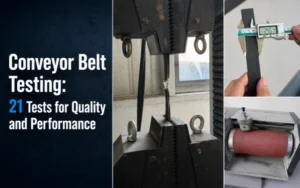
A full-thickness longitudinal specimen is clamped in a tensile testing machine and pulled until the fabric carcass ruptures. The computer records the maximum resistance at rupture and displays the Finished Belt Tensile Strength directly in N/mm. Routine factory inspection does not require the operator to calculate the result manually.
6.6 Can EP200 Alone Determine the Minimum Pulley Diameter?
EP200 alone cannot determine the minimum pulley diameter. The check also requires the Finished Belt Tensile Strength, Number of Fabric Plies, carcass thickness, splice method, and the position and duty of the pulley. Two belts made with EP200 fabric may therefore require different minimum pulley diameters.