In 2023, a salt loading facility in Western Australia replaced their conveyor belt after just 14 months—half the expected life. The belt looked fine: minimal thickness loss, no visible cracks. But it had become rigid, friction was inconsistent, and they were adjusting tension weekly. The plant manager told us: ‘We bought the strongest belt available.
How did it fail so fast?
1.Why Salt Conveyor Belts Are Not Typical Bulk Material Handling
Your salt belt is dying right now—and you can’t see it. No cracks. No visible wear. Thickness? Still acceptable. But the rubber is hardening, friction is drifting, and you’re adjusting tension more often. In 3-6 months, you’ll face an unexpected shutdown. This is how salt belts fail: silently, predictably, and expensively. Here’s what’s actually happening…
Salt is a crystalline material with defined edges, not an inert lump. At the microscopic level, Picture salt crystals under a microscope: each one is a tiny cube with knife-sharp edges. As tons of salt slide across the belt, these edges don’t just rub—they cut. Not deep enough to see, but enough to sever the molecular chains in the rubber surface. After millions of passes, the rubber loses its springiness. It becomes brittle. This explains why DIN abrasion values may appear “acceptable” under salt conveyor belt conditions, yet actual service life remains disproportionately short.
More critically, salt exhibits chemical behavior. It is hygroscopic, forming brine films in humid environments. When salt is discharged from a conveyor belt, repeated dissolution-recrystallization cycles accelerate rubber hardening and surface crack propagation.
Salt belt failure typically stems not from strength limitations, but from the gradual depletion of cover rubber properties.
This is the fundamental reason why “correct strength ≠ correct selection” in salt conveyor belt design.
2.How Salt Abrasion Damages Salt Conveyor Belts Over Time
In salt conveyor belt operations, the issue is never “how fast it wears,” but rather how wear persists unnoticed over time.
2.1 Crystal Micro-Cutting Mechanism
Salt particles are not smooth bulk materials but cubic crystalline structures with regular edges. During conveyance, these edges repeatedly embed into the rubber surface under load, creating continuous yet extremely shallow micro-cutting tracks. This type of wear rarely manifests as visible thickness loss but preferentially destroys the elastic network structure of the rubber surface, gradually degrading the cover rubber’s inherent cushioning and rebound properties.
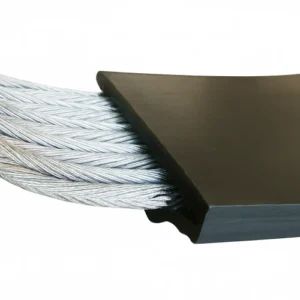
Salt particles are small in size yet numerous, resulting in extremely high contact frequency with the belt. A conveyor belt is not a rigid body but a typical “elastic composite.” The structure of a salt conveyor belt essentially consists of: an upper cover layer bearing the salt, an intermediate layer of EP, Nylon (NN), or steel cord reinforcement, and a lower cover layer contacting the idlers and drums.
When salt loads are applied to the upper surface, the force is not confined to the top cover rubber. Instead, it transmits downward through the reinforcement layers, interacting with the counter-supporting forces from the idlers and drums to create a full-thickness compression-bending stress field. Surface damage caused by micro-shearing is continuously amplified within this holistic stress state.
Belt Thickness | Surface Strain (%) | Typical Life (months) |
6mm | 2.3 | 18-24 |
10mm | 3.8 | 24-30 |
15mm | 5.7 | 22-28 |
2.2 High-Frequency Fatigue-Type Wear
During actual operation, each pass of the belt over a roller completes a full cycle of micro-bending and recovery. While the amplitude of each individual deformation is small—well below the material’s ultimate strength—its occurrence frequency is extremely high. When salt is poured from a conveyor belt, the belt remains under load across nearly its entire operational span rather than experiencing intermittent stress.
This high-frequency, low-amplitude cyclic deformation causes the surface layer—already weakened by micro-cutting—to enter a fatigue state first. Rubber hardness gradually increases while elasticity progressively decreases, yet no obvious cracks or abnormal wear become apparent for an extended period. This explains why salt conveyors often exhibit belts that “appear fine but have significantly degraded performance.”
We analyzed a failed belt from a salt conveyor in Chile. Surface wear: only 2mm. But under microscope? The rubber surface showed thousands of micro-shear tracks—like a cutting board after years of use. Hardness had increased from Shore A 65 to 78. The belt didn’t wear out; it aged out.
2.3 Wear Amplification Effect in Moisture-Affected Rubber
When ambient relative humidity approaches or exceeds 75% (the deliquescence threshold for NaCl at 25°C), salt begins absorbing moisture on the rubber surface, forming localized brine layers. At this stage, the cover rubber is not undergoing “chemical corrosion” but rather experiencing temporary softening and changes in friction coefficient. Under experimental conditions, the surface shear strain of rubber under wet loading is significantly higher than in dry conditions, directly amplifying the actual cutting action between crystals and rubber.
As operation continues, moisture evaporates under ventilation or temperature changes, causing dissolved salts to recrystallize. New crystal edges then re-engage in contact. This process is not an isolated event in wet conditions but a daily recurring cycle. Consequently, micro-shear damage originally dispersed across the surface gradually connects into continuous zones. Localized stress concentrations intensify, providing stable pathways for subsequent hardening and crack propagation.
Under wet conditions, the actual strain amplitude during each flexural cycle is amplified, increasing the effective depth of micro-shearing. The end result is that while the surface appears to show only normal wear, the material’s internal fatigue resistance is progressively weakened, setting the stage for subsequent sudden hardening, cracking, and failure.
3.Moisture and Corrosion in Salt Conveyor Belts
At the operational site of a salt conveyor belt, you never face a single issue. Salt, moisture, and tension conditions often coexist, compounding each other to progressively push existing wear toward failure. What you see may appear “still functional,” but irreversible changes are already occurring within the belt.
3.1 Chloride Ion Penetration Pathways
The brine layer mentioned above may not be visually apparent on-site, yet the rubber remains continuously exposed to wet, chloride-laden conditions. Chloride ions do not directly corrode rubber but steadily penetrate inward through microscopic defects created by prior micro-abrasion and wear. This keeps these areas perpetually non-dry.
For you, this means the cover rubber becomes more susceptible to aging and performance degradation. However, these changes typically manifest first in elasticity and rebound properties, not in strength or thickness. Precisely for this reason, salt conveyor sites rarely detect obvious abnormalities at this stage.
3.2 Microcracks → Aging → Structural Failure
Once brine infiltrates these microcracks, the problem extends beyond the surface. As you continue operating the belt, the cover rubber undergoes accelerated aging internally. Simultaneously, the tensioning system quietly intervenes. With manual tensioning, you’ll notice increased adjustment frequency; with counterweight or automatic tensioning, it continuously compensates, pulling the belt back to an “apparently adequate” state.
This compensation itself doesn’t immediately cause problems, but it signifies a critical fact: to maintain the same operating state, the belt is enduring higher average tensile stress. Under prolonged exposure to salt and moisture, this increased stress further reduces the fatigue margin of the cover and reinforcement layers, making existing microcracks more prone to propagation. What you perceive on-site might simply be “needing to adjust the tension more frequently lately,” making it difficult to immediately connect this to material aging.
3.3 Why Salt Belts Often Fail Suddenly
This is precisely where salt conveyor belts are most prone to misjudgment. Early wear progresses slowly with minimal visible changes, and the tensioning system continuously compensates, making operational conditions appear consistently manageable. What you observe daily is a belt still conveying reliably, not one nearing its limits.
Salt, moisture, and tension combined – the belt fails fast. Small cracks grow until it snaps. Looks sudden, but the damage built up over months. The early cracks were there, just nobody noticed or thought it mattered.
4.Typical Failure Modes in Salt Conveyor Belt Applications
In practical salt conveyor belt applications, failure manifests as a series of easily overlooked yet highly consistent patterns: performance degrades first, followed by visible signs, with operation sustained through compensation. If you cross-reference these points on-site, you’ll readily discover these issues aren’t isolated incidents but rather the norm under salt conditions.
4.1 Cover Hardening and Cracking
You’ll first notice the cover rubber “hardening” without significant thickness loss. This results from the combined effects of long-term micro-abrasion, wet aging, and sustained tension. Once hardened, the rubber’s ability to absorb bending and impact stresses diminishes markedly, leading to fine cracks that rapidly propagate during operation.
4.2 Edge Deterioration in Humid Salt Environments
In humid salt environments, edge rubber often shows problems earlier than the center section. The reason is straightforward: edges are more exposed to air and moisture while also being stress concentration zones. Once edge rubber begins to age and crack, you’ll notice a marked increase in misalignment risks and localized delamination issues, even if the main cover rubber still appears “serviceable.”
4.3 Surface wear without visible thickness loss
This represents one of the most deceptive failure modes in salt conveyor applications. The belt surface may appear minimally worn, and even caliper measurements may show negligible thickness loss. However, operational performance—including friction characteristics, rebound capacity, and fatigue resistance—has already deteriorated significantly. Such failures typically stem from the long-term accumulation of micro-crystalline cutting and high-frequency bending fatigue.
4.4 Slippage caused by moisture and salt buildup
Both the evaporation of saltwater films and the residual crystalline particles weaken effective frictional contact between the rubber and the rollers, leading to unstable friction coefficients. Minor slippage can often be temporarily alleviated by increasing tension. However, if slippage recurs with humidity and salt levels, and tension adjustments become increasingly frequent, it typically indicates that the surface friction characteristics and material condition of the salt conveyor belt have changed—not merely insufficient tension.
5.Engineering Criteria for Proper Salt Conveyor Belt Selection
By now, you understand one thing clearly: selecting a salt conveyor belt isn’t about whether it’s “strong enough,” but whether it can “operate reliably over the long term.” The following points represent engineering judgment logic derived from nearly 30 years of customer feedback and repeated validation of salt conveyor belt products in salt environments—ready for immediate application.
5.1 Cover Rubber Performance Requirements in Salt Handling
In salt conveyor belt applications, the primary task of the cover rubber is not impact resistance, but maintaining stable performance under wet conditions, micro-cutting, and high-frequency bending. Your focus should be on:
- Friction stability of the cover rubber in wet conditions
- Hardness trend after prolonged operation
- Ability to inhibit microcrack propagation
If a belt exhibits significant early hardening or friction fluctuations, it will struggle to endure long-term salt service—regardless of favorable DIN abrasion data.
5.2 Carcass Selection: When EP Belts Are Sufficient
Many salt conveying systems do not require excessively high-strength carcasses, as salt conveyor belts typically encounter no high-load scenarios. Provided conveying length, tension levels, and startup methods are appropriately managed, EP construction is fully adequate for most salt applications.
The critical factors lie not in nominal strength, but in:
- Reinforcement stability under high-frequency bending
- Reliable adhesion between reinforcement and cover rubber
Excessive strength redundancy may paradoxically increase system rigidity, accelerating surface fatigue.
5.3 Thickness and Structural Design Trade-offs
Cover rubber service life depends on material formulation, manufacturing conditions, and thickness. While increased thickness enhances abrasion resistance and impact resistance, it also:
- Increases bending strain (surface layer moves farther from neutral layer)
- Accelerates heat accumulation
- Amplifies compensation demands on tensioning systems
In conveyor belt design, a more rational approach is to select appropriate thickness for controllable fatigue behavior rather than simply adding material.
6.Common Selection Mistakes That Lead to Early Salt Conveyor Belt Replacement
In our salt conveying projects, these selection errors recur almost annually. Many projects start with perfectly correct parameters, yet experience significantly shorter operational lifespans. Post-mortems reveal the issue lies not in strength calculations, but in underestimating the chemical and physical properties of salt itself.
6.1 Relying Solely on Abrasion Resistance for Selection
Across multiple projects, we observed conveyor belts with acceptable abrasion data still exhibiting surface hardening and cracking within short cycles. The reason lies in the fact that the primary risk in salt environments isn’t material “wear-off,” but the continuous degradation of the rubber surface structure and elastic properties due to repeated exposure to brine. A single abrasion resistance metric fails to reflect this process.
6.2 Perceiving Acid/Alkali-Resistant Belts as Specialized or Redundant
In early salt conveying projects, acid/alkali-resistant belts were often viewed as solutions solely for extreme chemical environments. However, from a material behavior perspective, the core advantage of such rubber systems lies in their long-term stability against saltwater and ionic environments. Under persistent wet salt conditions, belts with acid/alkali resistance maintain more consistent operational performance in terms of aging rate, elasticity retention, and surface structural stability.
6.3 Focusing Only on Upper Cover Rubber While Neglecting Overall Structural Response
In some projects, selection criteria emphasize the abrasion resistance of the upper cover rubber, while insufficient attention is paid to the friction state between the lower cover rubber and rollers, or the bending fatigue of the reinforcement layers. Operational evidence shows that under salt conveying conditions, the entire belt ages synchronously due to wet conditions, high-frequency bending, and tension compensation. Localized optimizations rarely lead to overall service life improvements.
6.4 Addressing service life issues by increasing strength grades
Field verification confirms that elevating strength grades does not resolve premature failure in salt environments. Higher strength often entails increased operating tension and bending stress, accelerating fatigue accumulation in the cover. Provided conveying distance and startup conditions are reasonable, EP construction already provides sufficient load-bearing capacity for most salt conveyor belt systems.
6.5 Treating wet operation as an incidental condition
In salt conveying systems, wet conditions are not incidental but a persistent operational state. Saltwater formation, evaporation, and crystallization continuously impact surface friction and material properties. If this isn’t considered a prerequisite during selection, subsequent operation often relies on frequent tensioning and maintenance.
These experiences ultimately converge on one conclusion:
The critical factor in selecting salt conveyor belts lies in whether the material system can maintain stable performance under prolonged exposure to brine and wet conditions. The value of acid-alkali resistant conveyor belts in this application stems from the inherent stability of the material itself, not from assumptions about extreme chemical conditions.
Quick Action Checklist
If you’re specifying a new salt belt:
☐ Don’t default to highest strength grade
☐ Request acid-alkali resistant compound
☐ Specify cover thickness based on bending radius, not just wear
☐ Verify supplier‘s salt-specific experience
☐ Plan for 24-32 month replacement cycle (not 48+)
If your current belt shows these signs:
☐ Tension adjustments becoming more frequent
☐ Surface feels harder than when new
☐ Friction inconsistent in wet conditions
→ Start planning replacement now (6-12 months remaining)
Red flags in belt specifications:
✗ “Maximum abrasion resistance” as primary feature
✗ No mention of wet/saline stability
✗ Strength grade higher than load calculation requires
✗ Standard rubber compound (not salt-specific)
7.Conclusion
The service life of salt conveyor belts is determined by the material’s stability under prolonged exposure to brine and moisture, rather than by isolated parameters like abrasion resistance or tensile strength.
Performance degradation typically manifests first in elasticity, friction characteristics, and fatigue resistance, with changes in appearance and thickness often lagging behind.
When operation begins to rely on frequent tension adjustments, the issue has shifted from the operational level to the material level.
Provided the tension design is sound, excessively increasing strength does not yield higher reliability. Conversely, acid-alkali resistant conveyor belts with stability in saline and ionic environments are better equipped to maintain predictable long-term performance under NaCl salt transport conditions.
8.FAQs
FAQ 1: Can a salt conveyor belt recover once performance degradation has started?
No.
Once a salt conveyor belt shows persistent loss of elasticity, unstable friction, or rising tension demand, the degradation is irreversible. Maintenance can temporarily stabilize operation, but the material structure has already changed. At this stage, remaining life depends on stress level, not repair actions. Expecting recovery leads to delayed replacement and higher failure risk.
FAQ 2: Does overspecifying belt strength extend service life in salt applications?
No.
Increasing belt strength beyond actual load requirements does not slow saltwater-driven aging. In many cases, it increases operating tension and bending stress, accelerating fatigue. Strength protects against overload, not environmental degradation. In salt conveyor belt systems, material stability matters more than nominal strength.
FAQ 3: Can laboratory abrasion or aging tests predict real salt conveyor belt life?
No, not reliably.
Lab tests indicate relative material quality but cannot predict service life in salt systems. They do not replicate long-term wet–dry cycling under constant tension. Real belt life is determined by degradation rate in service, not initial test performance. Field data is always more predictive than lab numbers.
FAQ 4: Should maintenance be intensified once salt-related issues appear?
No—maintenance should trigger reassessment, not escalation.
When maintenance actions mainly compensate for material degradation—frequent cleaning, repeated tension adjustment—they stop being cost-effective. Continuing maintenance delays failure but increases downtime risk. At this point, replacement planning is the correct response.
FAQ 5: Does intermittent operation reduce stress on salt conveyor belts?
No, it usually increases damage.
Intermittent operation increases moisture cycling. During downtime, belts cool and absorb moisture; during startup, stress is applied to already softened material. This accelerates surface aging compared to stable continuous operation. Salt conveyor belts in intermittent systems require more conservative material selection.
FAQ 6: Is salt conveyor belt failure primarily caused by load or environment?
Environment first, load second.
Saltwater exposure degrades material properties early. Load determines how quickly the weakened belt reaches failure. If material stability is poor, even moderate loads will lead to early failure. Load alone rarely explains premature belt replacement in salt systems.
FAQ 7: Are “acid-alkali resistant conveyor belts” justified for NaCl salt transport?
Yes.
In NaCl applications, acid-alkali resistant conveyor belts are valuable because they offer better resistance to saltwater penetration and long-term moisture exposure—not because of pH extremes. Their benefit lies in material stability under ionic and wet conditions, which directly affects service life.