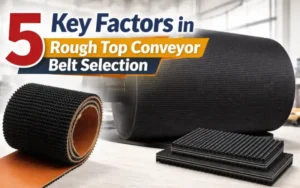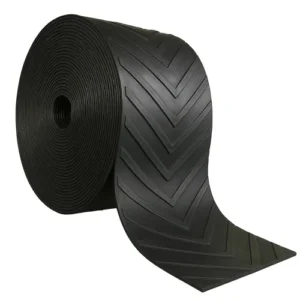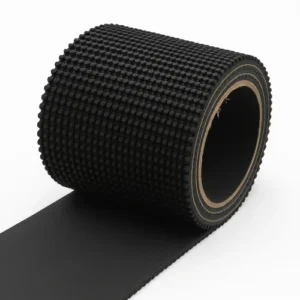
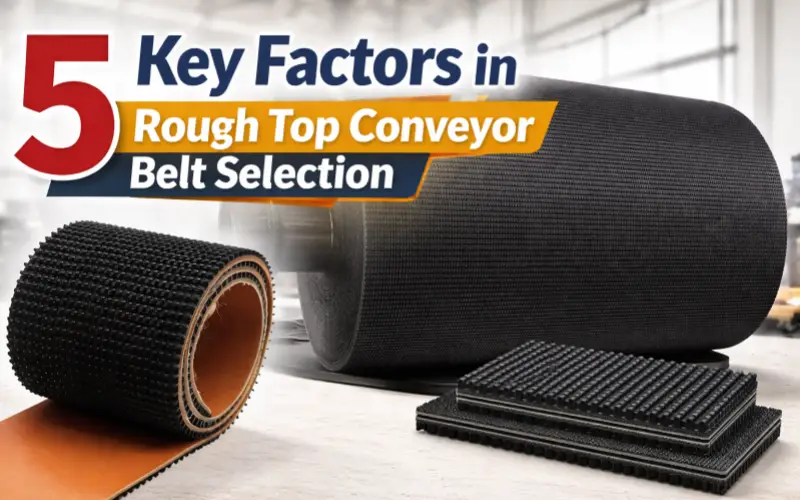
This article defines the engineering role of the rough top conveyor belt as a surface-based friction solution rather than a structural upgrade. By analyzing friction coefficients, material behavior, inclination limits, manufacturing differences, and real industrial applications, it demonstrates where rough top rubber conveyor belts become a rational intermediate choice—specifically when flat belts approach stability limits but structural conveying solutions are unnecessary. The focus is on predictability, controllable friction margins, and long-term operational stability.
1.Why Material Slip Occurs on Rough Top Conveyor Belt Systems
In the engineering context of rough top conveyor belts, the “slip” you discuss refers to only one phenomenon: the relative slip of material against the rubber surface covering the belt. It is neither belt slippage on the drive rollers nor belt misalignment. Without clearly defining this interface, assessments regarding inclination, start/stop operations, or stability lose their engineering significance.
The occurrence of material slip is typically assessed by evaluating whether the coefficient of friction (μ) between the material and the belt surface possesses sufficient safety margin. According to the engineering value ranges specified by the Conveyor Equipment Manufacturers Association (CEMA) and DIN 22101 / ISO 5048 for conveyor design calculations, the material-to-belt friction coefficient for flat rubber conveyor belts under dry, clean conditions generally falls within 0.30–0.35. This friction level is generally acceptable under moderate load and continuous operation. However, when the system operates under light loads, with irregular materials, or experiences frequent starts and stops, the friction margin significantly decreases, increasing sensitivity to operating conditions.
It is important to note that the start-up phase is not a “shortened version of steady-state operation.” According to the International Organization for Standardization’s ISO 5048 conveyor dynamics model, the equivalent friction requirement during start-up and acceleration phases is typically 1.3–1.6 times that of steady-state operation. When material weight is low, the already minimal normal force combined with this amplified requirement directly reduces the friction safety margin, potentially triggering slippage.
The engineering significance of rough top conveyor belts lies precisely in enhancing the effective friction coefficient between material and belt surface through structural design of the top cover. This brings the coefficient into the calculable range of 0.45–0.60 (CEMA engineering range). This difference is not merely a sensory “coarser” texture but a parameter change directly reflected in system capability. Without sidewalls, the safe angle of repose for a flat rubber belt is typically controlled around 10°, while a rough top belt extends this safe range to 15°–20°.
You must also understand this solution’s limitations: Rough top is only viable in systems where friction serves as the primary retention mechanism. Once the incline exceeds the friction limit, continuing to rely on rough top does not solve the problem from an engineering perspective—it merely delays failure. At this point, the system should transition to structural solutions like cleated, chevron, or sidewall belts.
When evaluating systems based on friction coefficients, start-up amplification effects, and tilt angle limits, the decision to use a rough top conveyor belt ceases to be an empirical judgment. Instead, it becomes a verifiable and reviewable engineering conclusion.
When evaluating systems based on friction coefficients, start-up amplification effects, and tilt angle limits, the decision to use a rough top conveyor belt ceases to be an empirical judgment. Instead, it becomes a verifiable and reviewable engineering conclusion.
2.What Sets a Rough Top Conveyor Belt Apart from a Flat Belt
When comparing rough top conveyor belts to flat rubber belts, one cannot focus solely on the “surface of the conveyor belt” itself. Instead, both the surface characteristics of the material being transported and whether a single contact interface exists between the material and the belt must be considered. Otherwise, assessments of friction and stability can easily become distorted in engineering practice.
In my view, the friction mechanism of flat rubber conveyor belts is fundamentally a model highly dependent on specific conditions being met. Within this model, material stability is primarily determined by three factors: material weight, operational state, and the surface matching relationship between the material and the belt surface. When transporting rough-surfaced, angular materials—such as crushed ore or unpolished rock fragments —a natural mechanical interlocking effect forms between the material and the belt surface. This can result in high slip resistance even on a flat belt.
However, this logic breaks down when material morphology changes. Take pebbles or washed, rounded stones as examples: their smooth surfaces and discrete contact points result in a state closer to point or line contact with the belt. Under these conditions, friction almost entirely reduces to the surface coefficient of friction itself, no longer relying on the “additional resistance” provided by shape. You will find that, under identical operating conditions, the stability of flat belts for such materials significantly decreases.
The distinction of rough top conveyor belts becomes evident precisely in these “uncontrollable material surface” conditions. By introducing structured textures onto the upper cover rubber surface, rough top belts do not attempt to alter the material itself. Instead, they artificially create a stable shear interface on the belt side. This enables the system to achieve relatively consistent friction responses even when handling smooth-surfaced, geometrically regular materials, without being entirely constrained by variations in material shape.
You must also note a frequently overlooked prerequisite: the effectiveness of rough top hinges on the existence of a clear, single contact surface between the material and the belt. When materials are laid in a single layer, transported in containers, or conveyed as regular components, belt surface friction directly governs material behavior. However, once material piling, multi-layer stacking, or mutual sliding between particles occurs, the movement of upper layers is primarily controlled by “material-to-material” friction. For instance, after secondary or tertiary crushing in a quarry, when inclined conveyors are used, even with chevron conveyor belts, occasional stone slippage occurs. The belt’s friction advantages become irrelevant to the upper material layer because it doesn’t directly contact the conveyor belt itself.
Therefore, the true engineering distinction lies not in whether the rough top is coarser, but whether it provides a stable friction interface independent of the material’s surface condition. Rough top belts demonstrate a substantial engineering advantage over smooth belts only when conveying regular-shaped items, single-layer materials, or materials with uncontrollable surface characteristics. Conversely, if the material is naturally rough, transported in piles, or relies primarily on interlocking between particles, the marginal value of rough top belts diminishes significantly.
3.When a Rough Top Conveyor Belt Is the Right Engineering Choice
In current industrial applications, rough top conveyor belts find their most stable and consistent use in systems handling wet materials, dusty conditions, moderate to low inclines, and requiring long-term predictable operational behavior. These scenarios do not demand extreme inclines or rely on complex structures, but instead place clear emphasis on the “stability of belt surface friction over years of operation.”
Within the precast concrete industry, rough top rubber belts are typically deployed in conveying sections between aggregate pre-treatment and batching. Here, they transport primarily washed sand and small-to-medium-sized crushed stone (around 10mm). Unlike transport modes that pile up products, these belts handle only a thin surface layer for screening fine materials. Moisture is not an occasional occurrence but a standard operating condition.
At medium-low inclines of 8°–12°, PVC conveyor belts suffer from accelerated wear and friction loss under current conditions, rendering them unsuitable for sustained operation. Chevron belts, meanwhile, are prone to material residue and adhesion in wet sand conditions, directly compromising batching accuracy. As previously discussed in my articles, when chevron height exceeds 6mm, it disrupts production processes and causes costs to increase exponentially.
In this scenario, the irreplaceable value of rough-top rubber conveyor belts lies not in “anti-slip capability,” but in their gradual and predictable friction performance degradation under prolonged exposure to wet materials and dust. This stability is critical for concrete batching system reliability.
Similar logic applies to asphalt mixing plants (AMP). In the inclined conveying section from the cold aggregate bin to the aggregate elevator, materials often enter the system directly after exposure to rain or spray, resulting in significant fluctuations in moisture content. Additionally, the equipment operates continuously in an open-air environment. Flat rubber belts exhibit markedly reduced stability under wet conditions. PVC fails to meet engineering requirements regarding temperature resistance, wear resistance, and impact resistance, while Chevron belts are prone to material jamming and accumulation with cold aggregates.
Consequently, asphalt plants remain one of the industries where Rough Top rubber conveyor belts enjoy consistently high repurchase rates. Customers don’t merely “try them out”; they recognize Rough Top belts as one of the few products maintaining acceptable operational performance under uncontrollable moisture conditions.
In the glass raw material handling sector, the engineering rationale for rough top belts is even more “pure.” Materials like quartz sand and feldspar possess extremely smooth surfaces that facilitate rolling yet carry substantial unit weight. PVC belts fail in wear life, Chevron belts disrupt material flow patterns, and flat rubber belts experience relative displacement during starts/stops and cycle rate changes.
Here, selecting rough top conveyor belts isn’t about compensating for insufficient load capacity, but because: the material itself provides almost no friction, leaving this function entirely to the belt surface. This represents an exceptionally clean application scenario, making it one of the most compelling use cases for rough top belts in mineral processing.
The final, equally important yet often overlooked application source is retrofit projects at established cement and building materials plants. These systems, typically built 15–30 years ago, have fixed geometries, spatial constraints, and drive configurations. The customer’s primary goal isn’t performance enhancement but simply “preventing further issues.” In partial replacement sections, Rough Top conveyor belts often emerge as the most readily accepted solution: they enhance operational stability significantly without altering the structure or introducing complex components.
From our factory’s perspective, these projects aren’t “new,” but they represent a genuine, consistent, and highly representative source of orders—though scenarios involving the transport of oily substances certainly exist.
Ultimately, the engineering value of rough top conveyor belts lies not in extreme conditions but in real-world applications. When systems endure prolonged exposure to moisture, dust, fluctuating moisture content, or frequent starts/stops—and structural modifications prove ineffective—rough top rubber conveyor belts emerge as a conservative yet rational engineering choice.
4.PVC and Rubber Rough Top Belts Serve Different Purposes
In practical applications of rough top conveyor belts, PVC does indeed hold a larger market share—this is a fact. However, in engineering selection, higher usage does not equate to suitability for all operating conditions. Many projects ultimately avoid PVC not because it is “inferior,” but because on-site conditions exceed the range where PVC can operate stably over the long term.
When conveying systems endure prolonged exposure to wet materials, sand dust, outdoor environments, and fluctuating moisture levels, the engineering focus becomes clear: the belt’s friction performance and its ability to remain functional after one year. If a material’s friction effectiveness heavily relies on surface cleanliness or dryness, stability becomes difficult to guarantee under such conditions.
If all these scenarios were addressed with PVC rough top conveyor belts, their service life might not exceed 3-4 months.
This is precisely the practical reason rough top rubber conveyor belts exist. These belts aren’t designed to perform better “right after installation,” but to degrade more slowly and predictably under consistently unfavorable conditions. In concrete precast, asphalt mixing, glass raw material handling, and retrofitting older plants, customers care less about “maximum slip resistance” and more about consistent performance today, next month, and next year.
A direct consequence emerges in these industries: when environmental controls cannot guarantee dry, clean conditions, selection naturally shifts toward rough-top rubber conveyor belts. This isn’t a matter of preference but one of availability. If a solution requires “ideal conditions” for stable operation, it struggles to become a long-term viable option in real industrial environments.
Therefore, this section isn’t about debating whether PVC or rubber is superior. It’s about recognizing that under prolonged wet material handling and continuous industrial operation, rough top rubber conveyor belts are the only rough top solution that maintains consistent performance. This is precisely why, in these industries, while they may not be the most widely used option, once deployed, they are rarely replaced.
5.Why Rough Top Rubber Belts Are Preferred in Demanding Conveyor Applications
In many conveying systems, the choice of a rough top conveyor belt depends not on the industry designation, but on the role and constraints of that conveyor line within the process. Even within the same industrial environment, transporting different products can impose entirely different demands on the conveyor belt.
In one typical application category, the conveyed material, operating cycle, and process steps themselves are stable over the long term, but the operating environment is less than ideal. Examples include persistent wet materials, dust, outdoor conditions, or fluctuating moisture content in raw materials. These systems do not frequently change conveying tasks but require consistent conveying behavior over extended periods. If the belt’s friction properties fluctuate with environmental changes, it directly impacts batching, metering, or downstream processes.
Under these constraints, rubber rough top belts are repeatedly chosen not because they suit “heavy-duty” transport, but because they exhibit lower sensitivity to environmental variations. The thicker rubber rough top coating slows wear and surface condition changes, preventing significant alterations in material behavior on the belt surface due to short-term moisture or contamination. This stability often outweighs the importance of initial friction levels.
Another practical consideration is scheduled replacement. In many well-funded and well-managed plants, belts are replaced at fixed intervals rather than waiting for failure. Under this model, the engineering focus shifts from “pushing to the limit” to maintaining acceptable performance throughout the entire lifecycle. If unpredictable friction degradation occurs during the mid-to-late stages, even without visible damage, production stability is compromised.
In such projects, the advantages of rough top rubber belts become more pronounced. Their wear process and friction changes are typically gradual, allowing field personnel to assess remaining service life based on operational status and visual inspection—rather than reacting passively to sudden material slippage issues. This predictability makes them easier to integrate into maintenance schedules, eliminating uncertainty.
Therefore, when systems demand consistent and cyclical conveying performance, rough top conveyor belts often represent a superior long-term choice. Their value lies not in handling extreme conditions, but in maintaining system stability under most real-world operating scenarios.
6.How Rough Top Rubber Conveyor Belts Are Manufactured
In terms of the manufacturing process for rubber conveyor belts, rough top rubber conveyor belts remain standard rubber conveyor belts.
Their fabric core structure, interlayer bonding, and overall vulcanization process are identical to those of ordinary flat rubber belts.
The true difference lies solely in the treatment of the top cover rubber.
1. The difference occurs only during the “top cover rubber stage”
Compared to flat rubber belts, rough top belts do not alter:
- Belt tensile structure
- Reinforcement material (EP / NN / Steel cord)
- Lower cover rubber configuration
The sole difference is that the upper cover rubber undergoes surface texturing while in the unvulcanized state.
This means rough top belts are not “post-processed”; instead, the surface design is completed in a single operation before the rubber vulcanizes.
2. Surface texture is directly embossed onto “unvulcanized rubber”
During calendering or molding, the unvulcanized top cover rubber is directly embossed with coarse patterns using:
- Patterned rollers
- Or specialized molds
This process has two key engineering implications:
- The surface structure is integral to the rubber body
- No laminated layers, coatings, or secondary bonding exist
Therefore, rough top surfaces won’t suddenly lose their texture during use.
They only gradually wear down as the rubber abrasion progresses.
3. Vulcanization isn’t merely a “process step”—it determines whether rough top holds up
For flat rubber belts, vulcanization primarily determines strength and durability.
But for Rough top rubber conveyor belts, vulcanization additionally determines one crucial thing:
Whether surface patterns can be permanently locked in place
Common issues arising from improper vulcanization include:
- Surface patterns flattening during early operation
- Patterns remaining visible but friction response rapidly diminishing
Thus, in rough top manufacturing,
vulcanization isn’t a routine step—it’s the critical factor directly impacting service life.
4. Why this process only holds true long-term within rubber systems
In rubber systems:
- Pattern = an integral part of the rubber
- Wear = a progressive process
- Friction variation = predictable
In non-rubber systems, surface friction often depends on the surface layer’s condition.
Once surface conditions change, performance can shift abruptly.
This is why Rough Top rubber conveyor belts maintain stable performance in wet materials, dusty environments, and long-term industrial settings—not just “working well when newly installed.”
7.Rough Top Conveyor Belt vs Flat Rubber Conveyor Belt — Practical Comparison
Within rubber conveyor belt systems, the distinction between rough top conveyor belts and flat rubber belts fundamentally lies in the source of system stability margin, rather than a judgment of product grade or quality. Clear differences exist between the two in design objectives, applicable inclination angles, and tolerance for operational fluctuations.
1. Applicability Boundaries Under Inclination and Height Drop Conditions
In engineering practice, flat rubber belts typically operate stably when conveying systems meet the following conditions:
- Materials are dry or have consistently stable moisture content
- Material surfaces exhibit sufficient roughness or interlocking characteristics
- Conveying inclination is generally maintained within the 6°–10° range
Within this range, material relies primarily on its own weight for friction, with the belt surface not bearing additional control functions.
As the inclination increases or significant height differences exist, stability increasingly depends on belt surface friction. For smooth, easily rolling, or water-washed materials, flat rubber belts may enter a low-stability margin operating range above 8°–10°.
Within the common industrial inclination range of 8°–12°, the purpose of introducing a rough top conveyor belt is:
To supplement friction sources through belt surface structure, restoring controllable margin to the system.
Beyond this range, engineering solutions typically prioritize sidewalls, patterns, or structural conveying designs rather than continued reliance on rough top.
2. Influencing Conditions: Moisture Content, Fine Particles, and Cleaning Systems
Minimal moisture or limited fine particle coverage does not inherently cause slippage. In systems equipped with effective polyurethane cleaners and relatively stable material conditions, belt surface conditions typically remain within acceptable limits.
Stability risks primarily arise under the following combinations:
- Periodic or seasonal fluctuations in material moisture content
- System operating point approaches design stability limits
- Fine material repeatedly accumulates over short periods, unable to be fully removed by the cleaning system
Under these circumstances, the flat rubber belt does not fail immediately; instead, its stability margin gradually diminishes.
The role of rough top is only valid under this premise. Its function is to buffer fluctuations, not to replace cleaning or material control systems.
3. Differences in Operational Monitoring and Replacement Strategies
During dynamic conveying, minor relative material slippage is an acceptable phenomenon and does not constitute grounds for failure determination. Flat rubber belts can operate long-term in most systems, with minor slippage not affecting overall functionality.
The primary differences manifest in systems operating near design boundaries:
- Flat belts’ operational status relies more heavily on real-time conditions
- Rough top rubber belts’ operational status is more concentrated within stable ranges
For plants employing scheduled replacement strategies, the focus is not solely on complete belt failure but on maintaining consistent operational behavior throughout the entire service life. If stability undergoes unpredictable changes mid-cycle, even an undamaged belt can disrupt maintenance schedules and production rhythms.
4. Applicability Limitations for Oil-Contaminated Materials
In scenarios involving oil-contaminated material conveyance, friction conditions objectively deteriorate significantly. It must be clarified that:
- Rough top cannot address continuous or heavy oil immersion conditions
- Under high oil film conditions, any friction-dependent solution will be limited
Rough top’s applicability is restricted to mild or intermittent oil contamination, provided the entire system remains within the friction-controllable range.
5. Prerequisites for Engineering Feasibility
The adoption of Rough top conveyor belts depends on the simultaneous presence of the following engineering conditions:
- The conveying incline or drop approaches the stability limit for flat rubber belts
- Material surface characteristics or state fluctuations cannot be fully eliminated through process means
- The cost incurred to achieve stable margin is lower than the cost of frequent adjustments or unplanned interventions
Only when these prerequisites are met does rough top constitute a reasonable engineering option, not a default choice.
8.Conclusion: The Objective Position of Rough Top Conveyor Belts in Engineering Systems
Within rubber conveyor belt systems, rough top conveyor belts should fundamentally be regarded as a surface engineering solution rather than a structural upgrade. Their core function lies not in enhancing load-bearing capacity or supporting extreme inclines, but in reintroducing and stabilizing friction reserves when system operation approaches stable boundaries.
From an engineering perspective, material slippage is determined by the material’s surface characteristics, the friction of the conveyor belt surface, and operating conditions (such as inclination angle and start/stop behavior). Under favorable material conditions and with sufficient system margin, a smooth rubber conveyor belt can operate stably over the long term. However, when operating within common industrial incline ranges (approximately 8°–12°), especially with smooth materials, fluctuating moisture content, or uncontrollable surface conditions, the available friction margin of flat belts significantly diminishes.
It is precisely within this non-extreme yet increasingly constrained operating range that rough top conveyor belts demonstrate distinct and independent engineering value. Through structural design of the upper cover surface, the Rough Top solution enhances the effective material-to-belt friction coefficient. This enables the system to regain controllable, stable margins without altering its geometric structure or conveying method.
The true value of Rough Top rubber conveyor belts lies not in peak performance under ideal conditions, but in predictability during prolonged suboptimal operation. In concrete precasting, asphalt mixing, glass raw material processing, and retrofitting existing plants, systems prioritize consistent conveying behavior over years of operation rather than short-term maximum slip resistance.
Therefore, the Rough Top conveyor belt should neither be considered a default configuration nor a substitute for sidewall, patterned, or other structural conveying solutions. Its engineering significance lies solely in addressing the question: When a smooth rubber belt approaches its stable service limit, yet structural solutions remain unnecessary, is there an intermediate, long-term viable solution?
Within this context, the Rough Top conveyor belt occupies neither a marginal nor a universal role. It is a clearly defined, conditionally specified engineering option—designed to bridge the stability gap between smooth conveying and structural conveying.
9.FAQs
- How should a rough top conveyor belt be stored to avoid surface damage before installation?
A Rough top conveyor belt should be stored horizontally on a flat surface or on a proper belt rack, without stacking heavy objects on top. Avoid point loads, sharp edges, and prolonged compression on the rough top surface. Storage areas should be dry, shaded, and temperature-stable. If coiled, the belt should remain on its core and not be laid flat under load.
- Can rough top rubber conveyor belts be re-lagged or resurfaced after wear?
No. Rough top rubber conveyor belt surfaces are formed integrally during manufacturing and cannot be effectively restored once worn. Re-lagging or resurfacing does not recreate the original surface structure or friction response. In practice, once the surface texture reaches its functional wear limit, replacement is the only reliable option.
- Is rough top conveyor belt suitable for short conveyors with frequent start–stop cycles?
Yes, Rough top conveyor belt is often suitable for short conveyors with frequent start–stop operations, especially when material weight is low or surface conditions are unstable. In these systems, start-up friction demand is proportionally higher than in long conveyors. Rough top helps maintain consistent material behavior during acceleration without relying on increased belt tension or structural modification.
- Are rough top conveyor belts sensitive to reverse running or direction changes?
They can be. Surface texture is optimized for friction in the primary conveying direction. Occasional reverse running is usually acceptable, but frequent direction changes may accelerate uneven surface wear. In systems requiring regular bidirectional operation, this factor should be evaluated during belt selection and maintenance planning.
- Can rough top belts compensate for poor conveyor alignment or structural vibration?
No. Rough top conveyor belt addresses surface friction only. Misalignment, excessive vibration, or structural instability cannot be corrected by surface texture and may actually accelerate uneven wear. Mechanical and structural issues must be resolved independently before considering rough top as a friction-based solution.
- Is rough top suitable for applications requiring precise material positioning?
Yes, within limits. Rough top surfaces improve positional stability for single-layer materials or packaged items by reducing relative slip. However, they are not designed for exact indexing or metering accuracy. For high-precision positioning, mechanical guides or controlled feeding systems are still required.
- Does rough top conveyor belt selection affect lead time or minimum order quantities?
Often yes. Rough top production requires specific surface tooling and scheduling, which may extend lead time compared to standard flat belts. Minimum order quantities can also be higher depending on manufacturer capability. This should be considered early in procurement planning, especially for retrofit or urgent replacement projects.