Rock crusher conveyor belt failures may not be caused by belt quality alone—different crushing stages load the belt in fundamentally different ways. If you’re facing repeated longitudinal tearing, accelerated abrasion, or splice-related failures in crushing systems, this article is for you. It explains stage-specific failure mechanisms and offers practical, system-based selection and correction strategies most suppliers overlook. Read on, identify the real failure driver in your circuit, and apply the right solution with confidence.
1. The Problems Faced by Rock Crusher Conveyor Belts Are Not Single-Condition Issues
In rock crushing projects, the sentence I least want to hear is: “This rock crusher conveyor belt is of poor quality.”
Because a complete site visit (sometimes with video recording) often reveals problems far more complex than that. A crushing system is not a single piece of equipment, but a complete, continuously operating process chain. However, many conveyor belt problems are simplified to “one operating condition” during the selection phase.
1.1 The Crushing System Consists of Multiple Stages, Not a Single Operating Condition
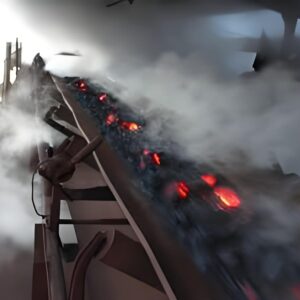
In actual operation, the impact of the crushed stone after primary, secondary, and tertiary crushing on the rock crusher conveyor belt is completely different. In the primary crushing stage, the material is large, heavy, and uncontrollable, instantly “slamming” onto the conveyor belt; from the secondary crushing stage onwards, the material size decreases, the pressure decreases, but there are more sharp edges; in the tertiary crushing stage, the impact weakens, but it becomes continuous wear. These three states have completely different damage mechanisms on the rock crusher conveyor belt.
1.2 The Direct Impact of Ignoring Differences in Crushing Stages on Conveyor Belt Selection
I’ve seen many projects use the same specification rock crusher conveyor belt from primary to tertiary crushing. The result is either the belt breaks first in the primary crushing stage, or longitudinal tearing begins in the secondary stage. It’s not that the conveyor belt is “cheapened,” but rather that the selection process assumed all stages would bear the same load—a fundamentally flawed premise.
1.3 Why Do “General-Purpose Conveyor Belts” Frequently Fail in Crushing Systems
So-called general-purpose rock crusher conveyor belts essentially make an average compromise between impact, tear resistance, and abrasion resistance. However, crushing systems never treat conveyor belts “equally”; they only target the weakest points. The result is that while it seems like anything can be used, in reality, none of the stages are functioning properly.
2. Typical Failure Modes of Rock Crusher Conveyor Belts in Crushing Systems
When your rock crusher conveyor belt malfunctions, analyze the conveying parameters to determine how it failed. In crushing systems, the failure modes of the conveyor belt are often already written on the belt surface, but many people fail to understand them.
2.1 Impact damage is not concentrated at “one point,” but rather repeatedly acts on a fixed material drop trajectory area.
If you stand next to the transfer point and observe carefully, you’ll find that the material’s drop trajectory is relatively stable, determined by the chute and guiding structure. Although the conveyor belt is rolling, it periodically passes through the same material drop trajectory coverage area.
If this area lacks sufficient buffering, the impact of large stones will repeatedly act on the same section of the belt surface. The result is usually not immediate belt penetration, but rather the cover rubber gradually being compacted and hardened, followed by localized penetration, eventually developing into structural damage. This type of problem mostly occurs at primary crushing or high-drop transfer points, rather than simply “the conveyor belt is not impact-resistant.”
2.2 Longitudinal Tearing Doesn’t Only Occur in Primary Crushing, But You Need to Understand the Tearing Mechanism
If you think longitudinal tearing is only related to large stones in primary crushing, field experience will quickly overturn this judgment. While primary crushing is indeed a high-risk area for impact tears, longitudinal tearing is equally common in secondary crushing systems.
The difference lies in the mechanism: the material size in secondary crushing is smaller, but the edges are sharper. When the conveyor belt is unbalanced, misaligned, or poorly guided, these sharp stones are easily “pulled” into the belt, forming a crack initiation point. Once cracking occurs, under tension, the tear will rapidly propagate longitudinally, appearing as a “sudden belt break,” but it is actually the result of long-term system problems accumulating.
2.3 Misalignment Itself Isn’t a Problem, But a Signal of System Imbalance
When you see the rock crusher conveyor belt start to misalign, don’t rush to correct it. For more information on misalignment, see my other article on conveyor belt alignment. This isn’t the key point; the key is to first identify the cause.
In rock crushing systems, the most common causes include: Misalignment of the material drop point, with aggregate not landing in the center of the conveyor belt; material shifting to one side in the chute; uneven stress on the buffer bed or idlers, or misalignment of these components with the conveyor centerline (this last point, while rare, has occurred in previous projects). These problems lead to continuous overloading on one side, causing premature damage to the edge rubber and the conveyor frame. Even with forced correction, the conveyor belt has already entered an irreversible wear phase.
2.4 Joints failing first often indicate the system has “chosen it as a weakness.”
If your conveyor belt breaks at the joint , it might be due to a faulty joint design, but consider this: how could a joint meeting production requirements break so easily? The joint fails first because it bears the most complex stress combination in the entire rock crusher conveyor belt: impact, bending, tension, and misalignment simultaneously.
Under unreasonable system design or operating conditions, the joint passively becomes a stress release outlet. In other words, early joint failure often means it’s “taking the blame” for the system’s problems.
3. High Impact Risk Analysis of Rock Crusher Conveyor Belts in the Primary Crushing Stage
If your rock crusher conveyor belt consistently experiences its shortest lifespan in the primary crushing stage, this is not accidental. The material after primary crushing is not just “large,” but also uncontrollable.
3.1 Weight, Size, and Uncontrollability of Material After Primary Crushing
In the primary crushing stage, the material size distribution is extremely uneven. Simultaneously, rocks weighing tens to hundreds of kilograms fall onto the conveyor belt along with fine particles. The problem lies with the heaviest rock; this is where the rock crusher conveyor belt truly tests its performance.
3.2 The Real Impact of Vertical Drop on the Impact Energy of Rock Crusher Conveyor Belts
Extreme weight is one factor, determining the magnitude of the force exerted on the conveyor belt. The height of the fall also needs to be considered. The greater the fall, the greater the potential energy of the heavier aggregate. If the fall height is too high, the impact will become what I described above: “smashing” onto the conveyor belt. With repeated impacts, the rubber surface ages, and the belt’s shock absorption capacity decreases. Eventually, this maximum shock will cause the conveyor belt to puncture instantly.
To illustrate, try hammering a thick piece of clay at a specific point. The hammered area will gradually thin until it punctures. Conveyor belts are punctured by impacts following a similar principle.
3.3 Most Common Conveyor Belt Damage Modes in the Primary Crushing Stage
In a primary crushing system, the typical damage sequence for a rock crusher conveyor belt is usually: First, the cover rubber is compacted → small cracks appear in localized areas → stress concentrates on the frame → eventually leading to penetration or structural failure.
If you find that the damage is always concentrated on the section of the belt before and after the material drop zone, rather than uniform wear across the entire belt, it’s almost certain that this is a “continuous accumulation” of high impact from the primary crushing stage, rather than a single accident.
4. Engineering Solutions for Rock Crusher Conveyor Belts in the Primary Crushing Stage
When you’ve confirmed a high impact issue in the primary crushing stage, the truly effective solution often lies not in “replacing with a more expensive rock crusher conveyor belt,” but in how to disperse, delay, or transfer the impact from the belt itself. The following adjustment sequence is crucial in itself.
4.1 Directly Reducing Impact Energy by Lowering the Drop Height
If you can only choose one most effective method, it’s to look at the drop height first. Impact energy has a square relationship with height; even a slight reduction in height will multiply the actual load on the rock crusher conveyor belt.
Ek = m × g × h
On-site, you should focus on: whether the chute is “suspended” and whether there are unnecessary free-fall sections. These kinds of problems are often more fatal than changing the conveyor belt specifications.
4.2 The Real Role of Buffer Tanks and Buffer Beds in Primary Crushing Systems
Many people install buffer beds simply to “support the conveyor belt.” But in a primary crushing system, its real value lies in: extending the impact time, rather than directly absorbing the impact force.
If you find that the cushioning bed travel is too short or the rubber blocks are too hard, the actual effect may be very limited; the rock crusher conveyor belt is still absorbing impact, just in a different way.
4.3 Optimize the chute structure and change the material entry method
You can focus on observing whether the material “slams” onto the belt surface or “slides” onto it.
A well-designed chute should allow the material to complete its orientation adjustment and release some energy before contacting the conveyor belt. Many belt breakage accidents are not essentially a problem with the belt itself, but rather caused by the material entering the belt directly perpendicularly.
4.4 Compensatory design for the rock crusher conveyor belt when the system cannot be adjusted
Only when the drop height, cushioning structure, and chute conditions cannot be optimized further should you focus on the rock crusher conveyor belt itself, such as adding a cushioning layer, optimizing the cover rubber formula, or improving local impact resistance.
If you try to combat impacts from the start by “thickening and hardening” the belt, the result is often that the belt is harder, but the system problems remain.Trust me, I want you to place an order (COntact us) with me more than anyone else, but I also want to say that replacing the conveyor belt with a more expensive one is often a last resort.
5. Complex Risk Characteristics of Rock Crusher Conveyor Belts in the Secondary Crushing Stage
When your rock crusher conveyor belt enters the secondary crushing system, the nature of the risk fundamentally changes. Time slowly wears down the conveyor belt. If you still use the mindset of primary crushing to judge secondary crushing problems, it’s easy to miss the key points.
5.1 The Real Challenges Arising from Changes in Material State in Secondary Crushing
In the secondary crushing stage, you are facing smaller, more numerous, and more angular stones. Individual pieces of material are no longer sufficient to generate destructive impact, but high-frequency contact begins to dominate the stress pattern of the conveyor belt.
For rock crusher conveyor belts, this means: impact becomes secondary, and continuous friction and cutting action begin to accumulate damage.
5.2 The Core Damage Mechanism in the Secondary Crushing Stage: Long-Term Accumulation of Cover Rubber Wear
Long-term observation of secondary crushing conveyor belts reveals that the problem does not “occur suddenly.” Small stones repeatedly slide, roll, and squeeze on the belt surface, gradually thinning the cover rubber. This wear is not obvious in the early stages, but once the thickness approaches a critical value, the internal skeleton is directly exposed to the abrasive environment.
At this point, the failure of the rock crusher conveyor belt has entered an irreversible stage. Because the exposed surface cannot withstand the high abrasion from small stones for an extended period, the rate of subsequent damage will accelerate significantly.
5.3 Typical Manifestations of Conveyor Belt Damage in the Secondary Crushing Stage
In a secondary crushing system, what you most often see is not a complete breakdown, but rather:
- The belt surface becomes thinner overall, and the texture is “polished.”
- Local areas wear through first, rather than suddenly breaking.
- After the frame is exposed, wear expands rapidly.
These phenomena almost all point to the same conclusion: the problem with secondary crushing is essentially a wear management issue, not insufficient impact resistance.
6. Risk Reduction Strategies for Rock Crusher Conveyor Belts in the Secondary Crushing Stage
Once your rock crusher conveyor belt enters the secondary crushing stage, it experiences daily minor wear. Your goal isn’t to “fight wear,” but rather to slow down, even out, and predict wear.
6.1 Reducing Uneven Loading and Localized Wear Through Material Distribution Control
Let’s look at an easily overlooked issue: Is the material consistently biased to one side of the belt surface?
In a secondary crushing system, even if the uneven loading isn’t significant, prolonged unilateral load will cause a noticeable difference in the wear rate of the cover rubber. The result is often: one side wears through first, while the other side still “looks new.”
If you find this situation, prioritize checking the chute outlet shape and guide plate position, rather than rushing to adjust the idler rollers.
6.2 Optimizing Transfer Points to Avoid Secondary Impact Amplifying Wear
Although secondary crushing isn’t primarily impact-driven, improper transfer points can still amplify wear problems.
If the material bounces, rebounds, or experiences a secondary drop at the transfer point, you are essentially reverting from a “wear-dominated” condition to a mixed “impact + wear” mode. This directly accelerates the wear rate of the rock crusher conveyor belt cover rubber.
You should focus on observing whether the material transitions smoothly in the direction of belt speed, rather than being disrupted before falling off the belt. If bouncing occurs, try lowering the crusher outlet height or choosing a gentler drop slope.
6.3 Targeted Configuration Principles for Rock Crusher Conveyor Belts in the Secondary Crushing Stage
Only after the wear has been balanced as much as possible at the system level should you consider the conveyor belt itself.
In the secondary crushing stage, you should focus more on:
- Whether the wear resistance rating of the cover rubber matches the operating time
- Whether an excessively high impact resistance design is needed (usually not)
- Whether the belt surface allows for more uniform wear rather than pursuing a “thick appearance”
In other words, the goal of selecting a belt for secondary crushing is not “to withstand an accident,” but “to stably complete its design life.”
7. Abrasion-Dominant Characteristics of Rock Crusher Conveyor Belts in the Third Crushing and Shaping Stages
When processing high-hardness, highly abrasive materials such as granite and basalt, three-stage crushing is not a design redundancy but a standard configuration.
When the system reaches the third crushing or shaping stage, the challenge is no longer “how to suppress abrasion under unstable conditions,” but rather how to control abrasion within a predictable and calculable range under highly stable operating conditions.
7.1 Why Third Crushing is a Conveyor Belt Operation “Independent of Secondary Crushing”
The core task of secondary crushing is to further crush large pieces of hard rock through compression; while the task of the third crushing or shaping stage is to refine, shape, and even meet sand production requirements of the already sufficiently crushed material.
This determines a key fact: In the third crushing stage, the material particle size is already highly concentrated, the system operation tends to be stable, impact is essentially eliminated, and abrasion becomes the only long-term force.
In contrast, secondary crushing is still in the stage where “the system is still being tamed,” and abrasion is often amplified by deviation, uneven loading, and transfer disturbances.
7.2 Fundamental Differences Between Secondary and Tertiary Crusher Belts in terms of Wear Patterns
If you disassemble and compare secondary and tertiary rock crusher conveyor belts simultaneously, you’ll find a very obvious difference:
- Secondary crusher wear is usually uneven, with localized areas showing noticeable initial damage.
- Tertiary crusher wear is more like “overall thinning,” with almost the entire belt wearing down simultaneously.
The reason isn’t the material itself, but the operating conditions.
Wear in the secondary crushing stage is often intertwined with systemic issues, representing “passively amplified wear”;
While wear in the tertiary crushing stage is stable wear resulting from the combined effects of material quantity, operating time, and wear resistance.
7.3 Actual Configuration Requirements for Rock Crusher Conveyor Belts in the Tertiary Crusher Stage
Precisely because the operating conditions in the tertiary crushing stage are highly stable, the conveyor belt configuration needs to be even more “restrained.”
At this stage, overemphasizing impact resistance and tear resistance often doesn’t translate to longer lifespan; it may even sacrifice wear resistance.
What you really need to focus on is:
- Whether the abrasion resistance rating of the cover rubber matches the design operating hours
- Whether the belt surface allows for long-term uniform wear, rather than localized load-bearing
- Whether the system has minimized off-center loading and abnormal friction
In other words, the third stage of crushing is not testing whether the rock crusher conveyor belt can “hold,” but rather whether it can “slowly wear down.”
8. Selecting the Appropriate Abrasion Grade for Rock Crusher Conveyor Belts
When the production line enters the tertiary crushing or shaping stage, you are facing a condition with stable abrasion and predictable lifespan. The selection of rock crusher conveyor belts is directly based on abrasion indicators.
At this stage, my core advice is summed up in one sentence:
Select an abrasion grade that “just covers the design life,” and if your budget allows, pursue the highest grade.
8.1 Technical Prerequisites for Selection in the Tertiary Crushing Stage
In a tertiary crushing system:
- Impact has been absorbed by the upstream crushing equipment.
- Material particle size is concentrated, and the flow pattern is stable.
- Conveyor belt abrasion is linear and continuous.
Under these conditions, laboratory abrasion test results (DIN/ISO) and field lifespan have direct reference value. This is the essential difference in selection logic between tertiary crushing and upstream crushing.
8.2 Solution 1 Main Body: Practical Recommendation Logic Based on DIN Wear Grades
Based on the actual operation of the tertiary crusher and shaping section, I typically recommend abrasion-resistant conveyor belts to customers according to the following logic:
8.2.1 Conventional Tertiary Cone Crusher + Screening System
Recommended Grade: DIN Y or DIN X
- DIN Y (≤150 mm³)
→ Meets the life requirements of most tertiary crusher shaping sections
- DIN X (≤120 mm³)
→ More stable life under high-hardness, high-abrasive rock conditions
This is the most cost-effective and widely used combination
8.2.2 VSI Sand Making System / High Sand Content Conditions
Recommended Grade: DIN X, DIN W if necessary
- High fine material proportion
- Significant wear from surface polishing and cutting
- DIN W (≤90 mm³) is practically meaningful in these conditions
However, DIN W is only suitable for clearly defined high abrasion requirements and should not be used indiscriminately.
8.2.3 Long-running triple crusher/forming section (>6000h/year)
Recommended grade: DIN X
- Most stable abrasion-cost curve
- Convenient for customer lifespan prediction and inventory management
- Without sacrificing flexibility and joint reliability
8.3 Why it’s not recommended to pay for “impact resistance” in the triple crusher stage
From the standards you provided, it’s clear that:
The essential difference between DIN and ISO abrasion resistance grades lies in abrasion rate, not tensile or elongation.
Under triple crusher conditions:
- Impact ≠ Lifespan limiting factor
- Abrasion = Real wear occurring daily
Paying for impact resistance will only squeeze your material budget for abrasion resistance.
8.4 DIN & ISO Abrasion Grade Comparison Selection Table
Applicable scenarios: Triple crusher/forming stage rock crusher conveyor belt
Standard system: DIN + ISO (most commonly used in international projects)
Typical Application Scenario | DIN Cover Grade | DIN Abrasion Loss (mm³) | ISO Cover Grade | ISO Abrasion Loss (mm³) | Selection Rationale |
Standard tertiary crushing & shaping | DIN Y | ≤ 150 | ISO D | ≤ 100 | Cost-effective solution for most tertiary crushing conveyors |
High-abrasion tertiary crushing | DIN X | ≤ 120 | ISO H | ≤ 120 | Improved wear stability under high abrasiveness |
VSI sand making system | DIN W | ≤ 90 | ISO H | ≤ 120 | Designed for severe fine-particle polishing and cutting abrasion |
Long operating hours (>6000 h/year) | DIN X | ≤ 120 | ISO D | ≤ 100 | Stable wear rate, easy life-cycle cost management |
Low-load or cost-sensitive shaping section | DIN Z | ≤ 250 | ISO L | ≤ 200 | Acceptable wear performance with lower initial cost |
9. Potential Risks of Using Rock Crusher Conveyor Belts Across Crushing Stages
In actual projects, it is absolutely unacceptable to use the same rock crusher conveyor belt to cover primary, secondary, and tertiary crushing stages. This is inherently a high-risk, and potentially flawed, decision. The problem lies in the fundamentally different ways conveyor belt lifespan is consumed at different crushing stages.
Primary crushing primarily consumes structural safety redundancy; secondary crushing consumes durability under system disturbance conditions; and tertiary crushing consumes stable, predictable wear life. When you attempt to use a single conveyor belt to handle all three consumption modes simultaneously, the most demanding stage will trigger failure first.
In the field, this configuration typically leads to three direct consequences:
- Failures are concentrated at critical transfer points or high-load sections, resulting in the greatest downtime costs;
- Premature failure of a section forces unplanned replacements of the entire line;
- The initial uniform selection, intended to reduce specifications, ultimately increases maintenance and inventory pressure.
Therefore, in my view, using the same rock crusher conveyor belt across crushing stages essentially trades downtime risk for superficial management convenience. From a long-term operational and total cost perspective, this is not a rational engineering choice.
10. How to Determine the Root Cause of Rock Crusher Conveyor Belt Problems
When a rock crusher conveyor belt malfunctions, many customers instinctively say, “It’s a product quality issue.” This isn’t a conclusion that can be drawn at a glance.
The key to determining the source of the problem isn’t “where it failed first,” but rather which operating condition is continuously amplifying the damage. If a transfer point is repeatedly generating impacts or disturbances, then all belt components passing through that location will be worn down more rapidly. If the system is already highly stable, and the belt body shows overall, uniform thinning, then the problem truly falls into the category of material and grade selection.
In engineering practice, you can use a simple diagnostic sequence to avoid detours:
- Uneven damage morphology and large lifespan fluctuations usually indicate that the system is still generating additional exposure. Prioritize checking the drop height, transfer structure, off-center loading, and belt misalignment.
- Uniform wear morphology and a lifespan highly correlated with operating time indicate that the system is basically stable. At this point, managing lifespan using DIN/ISO wear grades is an effective investment.
In other words, upgrading the rock crusher conveyor belt can only delay failure while the system is still “creating problems”; only when the system stops creating additional exposure will the upgrade in conveyor belt level truly translate into lifespan benefits.
11. Conclusion
The problems with rock crusher conveyor belts are solvable and controllable.
However, the prerequisite is that you must first clearly determine the current operating stage of the system.
If the system is still generating additional exposure—such as repeated impacts at transfer points, unstable material flow amplifying wear, and deviation requiring repeated hard adjustments—then replacing the conveyor belt with a higher-grade one only delays the onset of the problem, rather than solving it.
When the system has stabilized, and the conveyor belt exhibits overall, uniform wear that is highly correlated with operating time, the judgment becomes simpler:
At this point, use DIN/ISO standard products to manage lifespan, cost, and replacement cycles.
Therefore, you only need to remember three things:
1.Don’t upgrade the conveyor belt grade when the system is unstable.
2.Uneven wear indicates a problem that is not solely related to materials.
3.Only when wear is linear and predictable can the selection of a rock crusher conveyor belt truly “buy its lifespan.”
By achieving these three points, the conveyor belt will no longer be the most uncontrollable part of the crushing system, but will become a cost item that can be engineered and managed.
FAQ 1: When can wear data be prioritized over historical experience?
Wear data should only be prioritized over experience when at least four of the following five conditions are met simultaneously:
1.Wear rate is nearly linear.
- The deviation of the cover adhesive thickness over operating time is ≤ ±15%.
- No obvious “sudden acceleration” or “stage anomalies”.
2.Wear is basically consistent in the bandwidth direction.
- The thickness difference between the center and the edge is ≤ 20%.
- No premature wear on one side.
3.Continuous operating cycle ≥ 2000 hours.
- No structural or operational adjustments during this period.
4.Non-wear-related failure events are close to zero.
- Joints, misalignment, and abnormal impacts are not the main causes.
5.Material conditions are stable.
- No significant changes in lithology, particle size distribution, or sand content.
Unless this condition is met, experience is still more reliable than wear data.
FAQ 2: How to determine if current wear has entered the "irreversible stage of life"?
A very practical engineering threshold can be used to determine this:
- When the remaining cover rubber thickness is ≤ 30%–35% of the original thickness
- the wear rate begins to increase significantly (wear rate increases by ≥ 25% per hour)
the conveyor belt has entered the accelerated failure zone.
Continuing to operate will not linearly extend its lifespan; instead, it will significantly increase the risk of unplanned downtime.
FAQ 3: What wear rate is considered "normal," and what is considered "abnormal"?
Under stable three-stage operating conditions, a reference empirical range is:
- DIN Y / DIN X grades:
- Cover rubber wear rate ≈ 15–0.30 mm / 1000 hours
If your measured wear rate is consistently higher than 0.4 mm / 1000 hours,
the problem is usually not with the rubber grade, but with:
- material flow conditions
- width mismatch
- or the system is creating additional friction paths.
FAQ 4: Why do conveyor belts with the same wear grade have such different lifespans in different projects?
Because abrasion ratings only describe material loss per unit of energy and do not control the energy source.
In actual systems, bandwidth, material layer thickness, transfer method, and cleaning structure all alter the frictional energy input per unit area.
Therefore, abrasion ratings only determine the upper limit of lifespan after system stabilization, not the lifespan itself.
FAQ 5: Can a higher abrasion rating be replaced by "thicker cover rubber"?
In most cases, the answer is no.
Thicker cover rubber only linearly extends lifespan, while higher abrasion ratings may simultaneously reduce the abrasion rate.
When the abrasion rate itself is high, thickening only “wears out a thicker piece of rubber faster” and does not solve the fundamental problem.
FAQ 6: What is a reasonable range for the deviation between abrasion test data and field lifespan?
In a three-stage stabilization system, assuming consistent abrasion mechanisms, stable system operation, and elimination of non-abrasion failures, the deviation between the conveyor belt lifespan estimated from laboratory abrasion data and the actual field lifespan can usually be controlled within ±20%, an acceptable engineering range.
If the deviation significantly exceeds this range, the system conditions should be reviewed first, rather than questioning the test data itself.