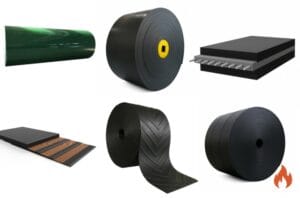
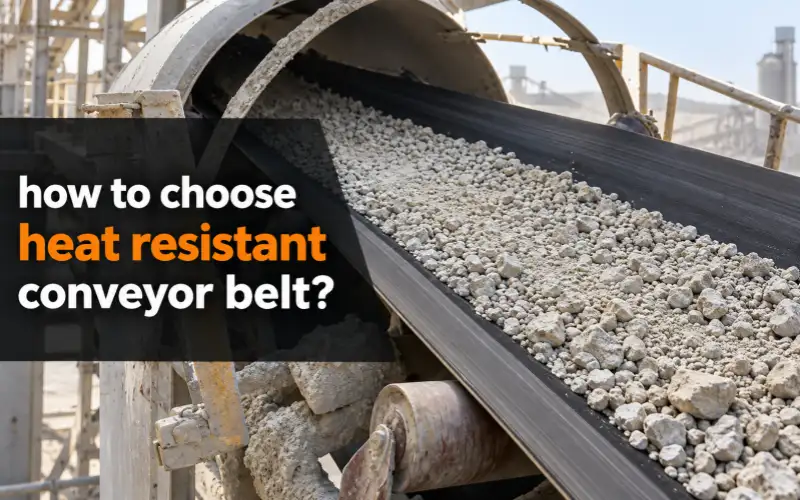
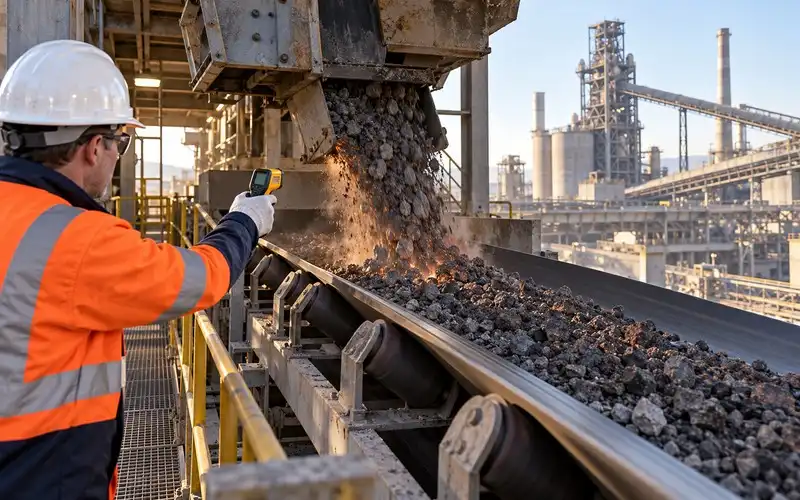
When you request heat resistant conveyor belts, we first ask for the continuous material temperature and the highest short-term peak. Both should describe the material as it reaches the belt. The continuous temperature establishes the requirement during normal conveying; the peak identifies a brief increase above that condition. You should also state the peak’s duration and frequency so its significance can be assessed.
These requirements help determine whether to recommend a heat resistant conveyor belt or evaluate a burn resistant design. The choice also depends on the material and whether its heat exposure can scorch the rubber cover. A high peak alone should not decide the belt type. I recommend checking the proposed product’s documented operating limits against both temperature requirements before confirming the belt specification and quotation.
1. Define the Temperature Requirements for the Quotation
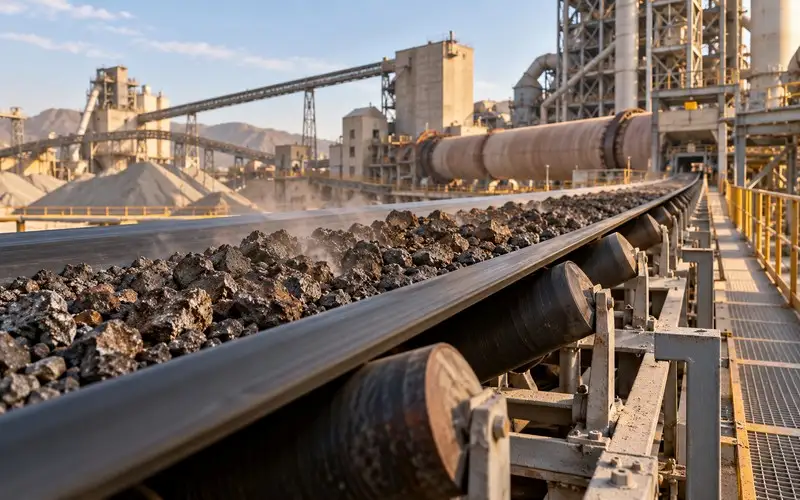
When requesting a quotation for a heat-resistant conveyor belt, describe the temperatures of the material the belt will carry. The two figures suppliers need first are the highest material temperature sustained during normal production and the maximum short-term material temperature. A peak temperature also needs an approximate duration and frequency; otherwise, the supplier cannot tell how it differs from the continuous duty.
Include in your inquiry | Details to provide |
Continuous temperature | The usual operating range and the highest material temperature sustained during normal production |
Short-term peak | The highest known material temperature, approximately how long it lasts, and how often it occurs |
Temperature data source | Where the temperature was recorded and whether the material passes through cooling or transfer stages before reaching the belt |
Multiple loading points | The temperature conditions at each point if they differ |
Use the process temperature records you already have. If the nearest reliable reading comes from an upstream location, identify that location and describe what happens before the material reaches the belt. Mark any estimated figures as estimates. This gives the supplier a usable basis for its recommendation without treating an upstream reading as a confirmed loading temperature.
The quotation should state the continuous and short-term material temperature conditions used to select the proposed belt. It should also state the peak duration or frequency assumed. If the supplier recommends a burn-resistant belt instead of a heat-resistant belt, ask which part of the reported duty calls for that construction. You can then check whether the quotation addresses the operating conditions in your inquiry.
2. Describe How the Material Loads the Belt
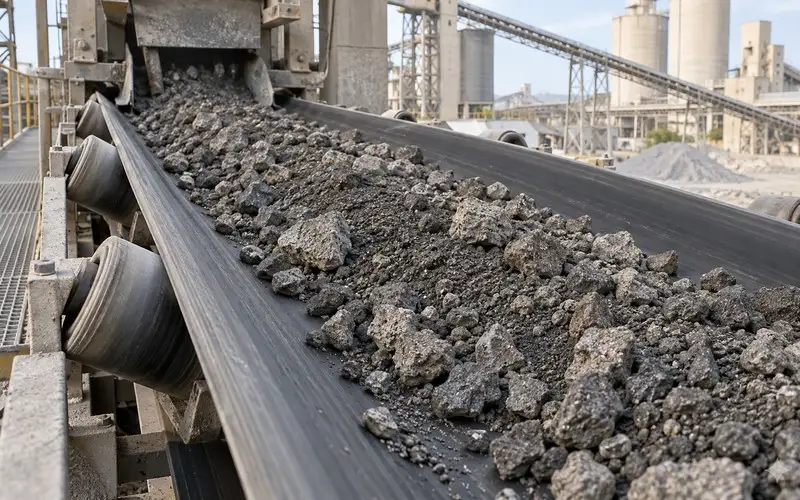
Material temperature sets the starting requirement. The supplier also needs to know how much hot material sits on the belt, how long it stays there, and whether loading causes wear or impact. These conditions can differ between conveyors carrying material at the same temperature.
2.1 Describe the Particle Size Distribution
Give the typical particle size range and an approximate proportion of fines. If the load contains both fines and large pieces, describe both.
Material on the Belt | What the Supplier Needs to Assess |
Mostly fines | Fines can form a continuous layer across the top cover. State how much of the load is fine material. |
Mostly large pieces | Gaps between pieces may leave parts of the cover exposed, while individual pieces can create concentrated loading. State the typical size range. |
A mixture | Fines may fill the gaps beneath larger pieces. Describe the mixture rather than naming only its largest lumps. |
This information helps the supplier assess the heat exposure pattern. The material name alone—for example, “clinker”—does not describe the size distribution on a particular line.
2.2 Report the Normal Load on the Belt
Provide the normal Tons Per Hour (TPH), approximate material bed depth, and how much of the belt width is usually covered. Also mention whether the load is fairly even across the belt or concentrated in one area.
These details show whether hot material normally forms a broad, continuous bed or passes over a narrower part of the top cover. For a replacement belt, describe the usual loading pattern, not just the conveyor’s maximum design capacity.
2.3 Account for the Loaded and Return Runs
Give the belt speed and the distance from the hot-material loading point to discharge. That distance divided by belt speed gives an approximate time that each section of belt carries the material on one pass.
Describe the return run as well, including whether it is enclosed or exposed to airflow. The supplier can then consider the time available for the belt to cool before it is loaded again. A change in belt speed affects both carrying time and return time, so the full belt cycle matters.
2.4 Include Wear and Loading Impact
State the maximum lump size, loading drop height, and whether the material is abrasive. If an existing belt is being replaced, report where its top cover has worn or cracked. The supplier can use this information to assess cover wear alongside heat resistance and to recommend the top cover construction for the actual loading conditions.
3. Understand What Heat-Resistance Data Actually Proves
When comparing quotations for a heat-resistant conveyor belt, ask for the datasheet of the exact belt model and specification being quoted. It includes belt dimensions, carcass strength, cover properties, adhesion, and heat-resistance parameters.
3.1 What Heat Does to the Rubber Cover
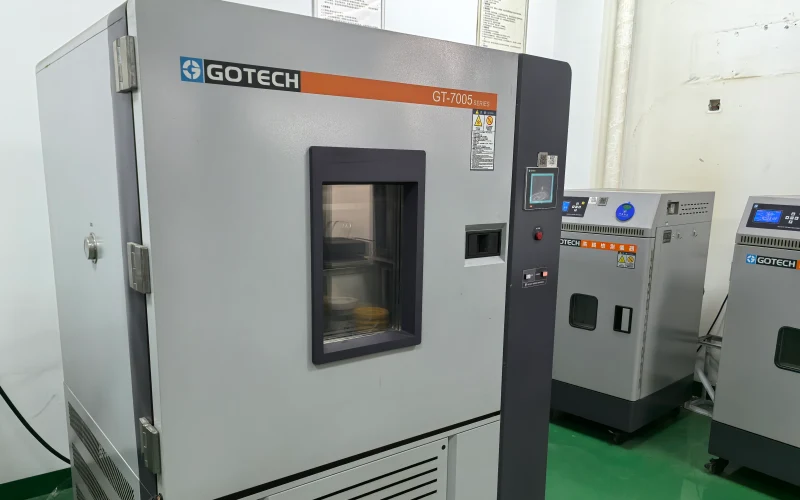
Heat aging changes rubber hardness, elongation at break, and tensile strength. The cover bends as it passes around pulleys. Lower elongation at break reduces how far the rubber stretches before rupture. For your purchase, I recommend checking the heat-aging parameters against the stated standard.
3.2 Read the Heat-Aging Parameters in the Datasheet
The heat-test section should list each parameter with its unit, reference limit, and stated value. Percentage entries need a clear label, such as change after aging or retention after aging. These quantities use different limits, even though both carry a percent sign.
Hardness change is expressed in points on the stated hardness scale. Buyers should read that entry separately from the percentage changes used for tensile strength and elongation.
3.3 Check the Datasheet Against the Stated Standard
Compare the listed values with the requirements for the standard and heat-resistance class specified for the quoted belt.
Cover Property | Datasheet Parameter | What to Check Against the Standard |
Hardness | Hardness change after aging, in points | Permitted hardness change and any specified final hardness limit |
Elongation at break (%) | Percentage change after aging | Permitted change and any specified minimum after aging |
Cover-rubber tensile strength (MPa) | Percentage change after aging | Permitted change and any specified minimum after aging |
A common buying mistake is accepting a listed heat-aging figure without checking the allowable range. Illustrative comparison: With an assumed permitted change of ±40%, a result of 20% passes that item, but 45% exceeds the limit. If the standard also specifies a minimum value after aging, that requirement needs to be met as well.
4. Specify the Right Rubber Covers
For your heat-resistant conveyor belt, we match the cover compound to the conveying duty and specify top and bottom cover thicknesses separately. Our quotation includes the cover grade, abrasion requirement, and thickness of each cover.
4.1 Select the Cover Compound by Performance Under the Actual Duty
We normally select the cover compound based on your continuous and peak material temperatures, material contact conditions, and abrasion requirements. SBR and EPDM identify base polymers; the finished formulation determines the cover’s properties. For abrasive hot material, we recommend specifying both the required heat gradeand an abrasion-loss limit.
An abrasion-loss value reported in mm³ measures the rubber volume removed during testing. Under the same method and conditions, a lower value means less rubber lost in that test. For your comparison, use abrasion-loss values from belts that meet the required heat duty. These figures compare laboratory wear resistance rather than predict service life. cdn.standards.iteh.ai
If your current cover wears too quickly, we recommend reviewing the abrasion requirement for the replacement belt. The replacement still needs the required heat grade.
4.2 Set Top and Bottom Cover Thickness Separately
We state top cover, bottom cover, and total belt thickness separately in your quotation. For textile belts, total thickness includes the covers, carcass, and interlayers. cdn.standards.iteh.ai
Specification | Basis for Selection |
Top cover thickness | Direct contact with hot material, protection of the carcass, and rubber allowance for wear |
Bottom cover thickness | Contact with pulleys and idlers, wear on the running side, and equipment requirements |
Total belt thickness | Finished belt dimensions and compatibility with the conveyor |
Additional top-cover thickness provides more wear allowance. But with the same carcass and compound, it also adds weight and increases bending stiffness. We select the thickness to suit your conveyor’s requirements for belt dimensions and flexibility.
A common buying mistake is comparing only total belt thickness. Illustrative example: With the same carcass, 6 mm top + 2 mm bottom and 4 mm top + 4 mm bottom both have 8 mm of combined cover thickness. The 6 + 2 construction provides 2 mm more top-cover rubber.
5. Check the Carcass and Bonding of the Heat-Resistant Conveyor Belt
5.1 Confirm Carcass Construction and Ply Count
When your existing conveyor belt has performed well at the same material temperatures and throughput, its specification is the starting point for a replacement. If a general-purpose belt carrying hot clinker develops a hard, cracked top cover, we select a heat-resistant cover suited to that duty. If a heat-resistant belt selected for a lower heat duty shows local cover separation at a hot sinter loading point, we review its heat grade and the affected bond. Changes in throughput (TPH), lump size, or operating tension also call for a review of the carcass construction.
A conveyor belt’s longitudinal tensile rating depends on the fabric used and the ply construction. Adding a ply alone does not establish a higher strength rating. Illustrative comparison: EP500/5 has five plies and a nominal belt strength of 500 N/mm. EP630/4 has four plies and a higher nominal strength of 630 N/mm.
5.2 Verify Conveyor Belt Tensile Strength and Elongation
The conveyor belt’s longitudinal tensile strength is stated in N/mm. Cover-rubber tensile strength, stated in MPa, is a separate parameter. A replacement must meet the specified belt strength and both elongation requirements.
Parameter | Unit | What to Check |
Conveyor belt longitudinal tensile strength | N/mm | Meets the specified strength |
Elongation at break | % | Meets the specified minimum |
Elongation at the reference load | % | Does not exceed the specified maximum |
5.3 Examine Cover-to-Carcass and Inter-Ply Adhesion
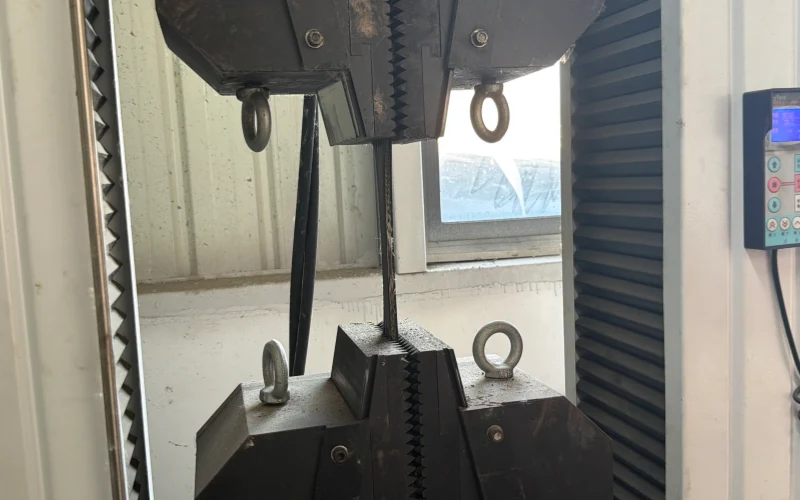
The top and bottom covers are bonded to the fabric carcass, and the fabric plies are bonded to one another. If the top cover lifts at a hot loading point, the top-cover-to-ply bond is the relevant interface to examine. The datasheet lists top-cover-to-ply, ply-to-ply, and bottom-cover-to-ply adhesion separately in N/mm. Each result is checked against the requirement for that interface.
6. Match the Quotation to the Model Datasheet
6.1 Confirm the Quoted Belt Model
The datasheet describes the complete conveyor belt model. We match the quoted carcass construction, longitudinal strength rating, ply count, width, top and bottom cover thicknesses, and heat grade to the specification shown on that model’s datasheet.
6.2 Compare Each Test Item With Its Requirement
The Belt Test, Cover Rubber Test, Adhesion Test, and Heat Test sections give the requirements for different properties of the same model. Where a Result is shown, we compare it with the Reference for that test item. This includes the heat-aging percentage results for cover-rubber tensile strength and elongation at break. Each result is assessed in its own unit against its own requirement.
6.3 Confirm Dimensions and Tolerances
Belt width, top cover thickness, bottom cover thickness, and total thickness are specified separately. Their tolerances also need to match the quoted specification. Illustrative datasheet entry: a 4.5 mm top cover with a ±5% tolerance and a 3.5 mm bottom cover with a ±0.2 mm tolerance are two separate dimensional requirements.
7. Turn the Analysis Into a Purchase Decision
7.1 What We Need in Your Operating Brief
We recommend a heat-resistant conveyor belt from the material conditions and the conveyor’s operating details. The brief for your application covers:
Area | Details |
Temperature | Normal and peak material temperatures at the loading point; how often the peak occurs and how long it lasts |
Material | Material name, lump size, proportion of fines and abrasiveness |
Load | Throughput, material bed depth and how much of the belt surface the load covers |
Conveyor | Belt width, speed, conveying distance and current belt specification |
Replacement objective | Where the current belt is damaged and which specifications the replacement needs to retain or change |
An unknown condition stays marked for confirmation. We do not treat a missing peak temperature as a lower-temperature application.
7.2 Comparing Quoted Models With the Same Fields
We identify the proposed conveyor belt model in the quotation and provide its corresponding datasheet. When you compare quoted models, the operating brief remains the same for each one. Material temperatures come from that brief; the belt specifications and test entries come from each model’s datasheet.
Comparison field | Entries for each quoted model |
Model | Full belt specification and heat grade |
Dimensions | Width; top cover, bottom cover and total thickness; stated tolerances |
Belt test | Longitudinal tensile strength, ply count, elongation at break and elongation at reference load |
Cover rubber test | Top and bottom cover tensile strength and elongation at break; abrasion and hardness |
Adhesion test | Top cover to ply, ply to ply and bottom cover to ply |
Heat test | Aging temperature and duration; percentage results for tensile strength and elongation at break, compared with their respective limits |

8. Match the Belt Specification to Actual Heat Exposure
Your material’s continuous and peak temperatures are the starting point for our recommendation. Particle size, bed depth, throughput and belt speed help us assess the belt’s heat exposure. If the existing belt has hardened, cracked or separated at the loading point, we also consider where and how the damage occurred.
We quote a complete heat-resistant conveyor belt model, including its carcass, ply count and cover thicknesses, and provide the matching datasheet. Its heat-aging percentage results are compared with the stated limits at the specified test temperature and duration. The laboratory aging temperature is not the allowable continuous temperature of the conveyed material.
9. FAQs
9.1 How Do I Choose a Heat-Resistance Grade for My Material?
We use the material’s normal temperature at the loading point and its peak temperature, including how often the peaks occur and how long they last, to recommend a heat-resistant grade. The heat-aging temperature on a conveyor belt datasheet is a laboratory test condition. It is not the maximum allowable temperature of the conveyed material.
9.2 When Do I Need a Burn-Resistant Conveyor Belt?
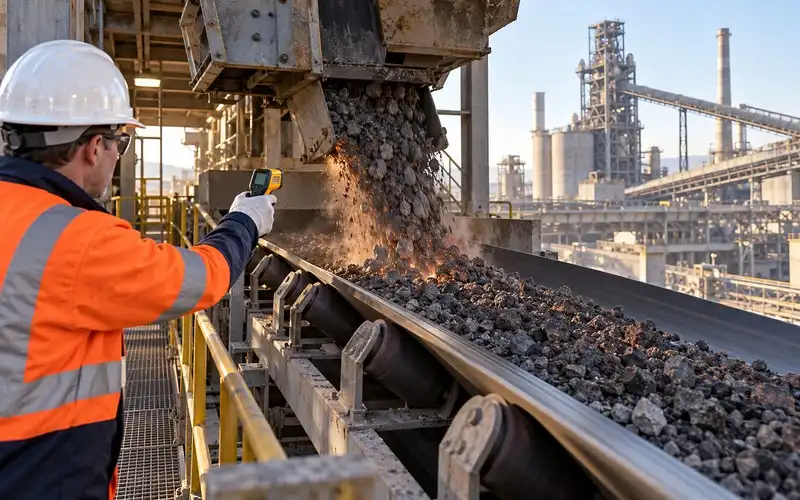
If you need to convey red-hot sinter, coke, or slag, or material containing glowing or smoldering particles, choose a burn-resistant conveyor belt. These materials can directly scorch the top cover on contact. For hot material without direct scorching, we recommend a heat-resistant grade based on its operating temperature and contact conditions.
9.3 Does a Thicker Top Cover Provide Greater Heat Resistance?
No. Adding more of the same cover rubber does not raise its heat-resistance grade. We select the top cover thickness for wear and impact at the carrying surface. When your material requires greater heat resistance, we recommend a cover compound with the appropriate grade.
9.4 Do Belt Speed and Conveying Distance Affect Heat-Resistant Belt Selection?
Yes. On the same conveyor, lowering the belt speed keeps hot material in contact with the belt surface for longer. At the same speed, a longer conveying distance also extends contact time before discharge. Throughput and bed depth matter as well: they affect how much hot material the belt carries during that time. We consider these conditions together when recommending a heat-resistant grade.